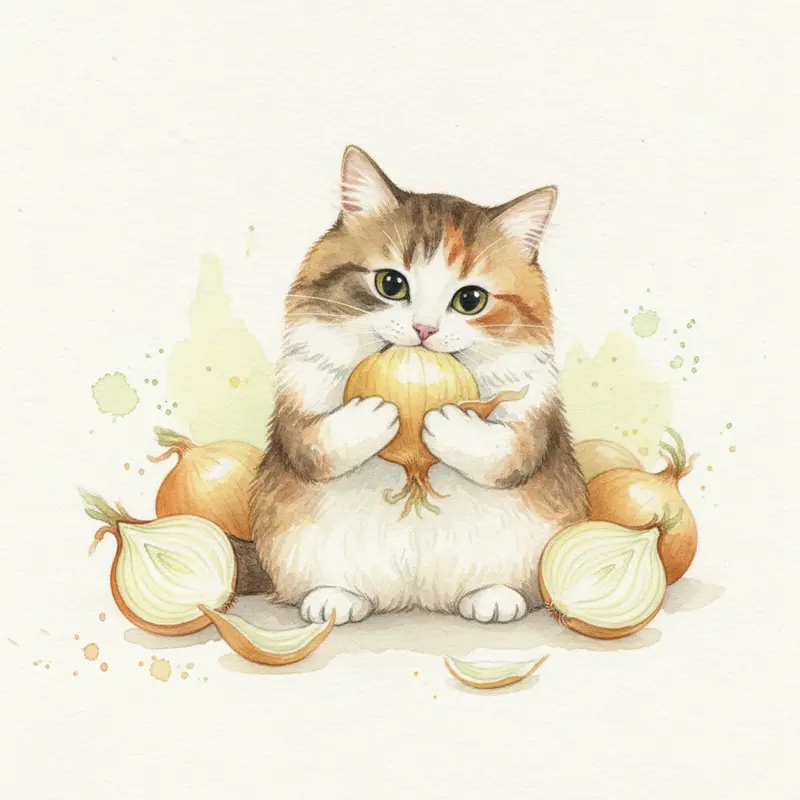
No, your cat should not eat onions.
Onions are toxic to cats in every form — raw, cooked, fried, dehydrated, and especially as powder. They contain sulfur compounds that destroy a cat's red blood cells and can cause a life-threatening anemia. No amount of onion is safe, and cats are far more sensitive than dogs. If your cat has eaten any onion or onion-containing food, contact your veterinarian right away — even if your cat seems fine, because the damage is delayed.
Why Onions Are Toxic to Cats
Onions belong to the Allium family of plants, along with garlic, leeks, shallots, chives, and scallions. Every part of the onion is dangerous: the bulb, the flesh, the leaves, and the juice.
When an onion is cut, crushed, chewed, or cooked, its sulfur compounds (sulfoxides) break down into thiosulfinates and organic disulfides. These compounds are absorbed through the gut and then attack the membranes of your cat’s red blood cells, causing oxidative damage. The cell walls become brittle and the damaged hemoglobin clumps into deposits called Heinz bodies. The damaged cells are then destroyed faster than the body can replace them, which leads to hemolytic anemia — not enough healthy red blood cells to carry oxygen around the body.
Cooking does not make onion safe. The toxic compounds survive frying, boiling, roasting, and baking.
Why Cats Are Hit Harder Than Dogs
Onion poisoning is serious in any pet, but cats are especially vulnerable, for two reasons:
- Their blood is built differently. A cat’s hemoglobin carries eight free sulfhydryl groups, compared with four in dogs and just two in humans. Those extra sulfur sites are exactly what the onion compounds attack, which makes feline red blood cells roughly two to three times more sensitive to oxidative damage than a dog’s.
- They are small. The average cat weighs only 4-5 kg, so a toxic dose is reached with a very small amount of food — far less than it would take to harm a medium or large dog.
This combination is why a quantity of onion that a big dog might shrug off can seriously poison a cat.
How Much Onion Is Dangerous
As little as 5 grams of onion per kilogram of body weight has caused clinically important blood changes in cats. Toxicosis is consistently seen when an animal eats more than 0.5% of its body weight in onion at once.
| Cat weight | Roughly this much raw onion can cause harm |
|---|---|
| 3 kg (kitten / small cat) | About 15 g — less than 2 teaspoons |
| 4.5 kg (average adult) | About 22 g — roughly 1 tablespoon |
| 6 kg (large cat) | About 30 g — a small wedge |
These are not safe amounts — they are the thresholds where measurable damage begins. The safe amount of onion for a cat is zero.
Two things make real life more dangerous than the table suggests:
- Repeated small doses add up. A little onion in the food bowl day after day can cause anemia even if no single meal would.
- Powder breaks the math. The figures above are for fresh onion, which is mostly water. Dried and powdered onion is concentrated, so a tiny amount weighs far more in toxic compound than the same spoonful of fresh onion.
Key Nutritional Facts: Onion Toxicity Reference (Cats)
- Toxic threshold: as little as 5 g onion per kg body weight
- Rule of thumb: more than 0.5% of body weight eaten at once
- Feline hemoglobin: 8 sulfhydryl groups vs 4 in dogs (2-3x more sensitive)
- Onset of anemia: usually 2-5 days after eating (can begin at 12 hours)
- Onion powder: far more concentrated than fresh — a pinch can be a large dose
- Applies equally to: garlic, leeks, shallots, chives, scallions, spring onions
The Hidden Danger: Onion Powder and Seasoned Food
Most cats will not sit down and eat a raw onion — they do not like the taste or smell. The real-world poisonings almost always come from cooked and seasoned human food, where onion is hidden, flavorful, and often carried on something a cat loves, like meat or dairy fat.
Onion powder is the single biggest culprit. Because it is dehydrated and ground, it packs the toxic compounds of a whole onion into a small sprinkle. It turns up in a surprising number of everyday foods:
- Baby food — many meat-flavored baby foods contain onion powder. This is a classic, well-documented cause of onion poisoning in cats, especially when people offer baby food to a sick or elderly cat who won’t eat.
- Gravy, broth, and stock — including stock cubes and the pan juices people spoon over a cat’s dinner as a “treat.”
- Soup and sauce mixes, bouillon, and seasoning blends
- Chips, crisps, and savoury snacks (onion or “sour cream & onion” flavours)
- Pizza, garlic bread, and many takeaway dishes
- Seasoned or marinated meats, meatballs, and leftovers
The lesson: a cat does not have to eat a visible piece of onion to be poisoned. A spoonful of gravy or a few licks of meat-flavored baby food can be enough. Never give your cat human leftovers or baby food without checking the ingredient list for onion, onion powder, garlic, or “natural flavors.”
Why “He Ate It Yesterday and He’s Fine” Is a Trap
This is the most important thing to understand about onion poisoning, and the part most owners get wrong.
The red blood cell damage is not immediate and not obvious. You may see mild stomach upset in the first day — but the dangerous anemia develops two to five days after your cat eats the onion (occasionally beginning as early as 12 hours). A cat can seem completely normal the evening after eating onion gravy and then become seriously ill days later, once enough red blood cells have been destroyed.
That delay is exactly why vets do not wait for symptoms. If the onion was eaten recently, early decontamination can stop much of it being absorbed in the first place — which is far better than treating full-blown anemia later. Do not adopt a wait-and-see approach. By the time your cat looks sick, the damage is already done.
Symptoms of Onion Poisoning in Cats
Watch for these signs, and remember the serious ones can be delayed by several days:
Early (first 24 hours — from stomach irritation):
- Vomiting
- Diarrhea
- Drooling or mouth irritation
- Loss of appetite
- Nausea
Later (2-5 days — as anemia develops):
- Lethargy, weakness, and sleeping more than usual
- Pale, white, or yellowish gums (check inside the lip)
- Rapid or labored breathing
- Increased heart rate
- Reddish-brown or dark “tea-colored” urine (a key warning sign of red blood cell breakdown)
- Reluctance to move or play, collapsing after mild exertion
- Yellow tint to the eyes or skin (jaundice)
Pale gums, dark urine, and breathlessness together are a red-alert combination — get to a vet immediately.
What to Do If Your Cat Eats Onion
- Do not wait for symptoms. Act now, even if your cat seems perfectly healthy.
- Remove any remaining onion or onion-containing food from reach.
- Note the details — the form (fresh, cooked, or powder — powder is worse), the amount, and when it was eaten.
- Call your veterinarian or an animal poison control line straight away.
- Do not try to make your cat vomit at home. Inducing vomiting in cats is risky and should only be done by a vet.
- Keep the packaging if the onion came from a processed food, so the vet can judge how concentrated it was.
Emergency contacts:
- Your local emergency veterinary clinic
- ASPCA Animal Poison Control Center: (888) 426-4435 (fee may apply)
- Pet Poison Helpline: (855) 764-7661 (fee may apply)
Veterinary Treatment
There is no specific antidote for onion toxicity — treatment is about limiting absorption and supporting the cat while the body replaces damaged blood cells:
- Decontamination — if the onion was eaten recently, the vet may induce vomiting and give activated charcoal to reduce absorption.
- Blood monitoring — because anemia is delayed, vets commonly check the packed cell volume (PCV) and a blood smear daily for about five days, watching for Heinz bodies and a falling red cell count.
- IV fluids — to support circulation, protect the kidneys from breakdown products, and help flush the system.
- Oxygen support — for cats struggling to breathe because their blood cannot carry enough oxygen.
- Blood transfusion — in severe cases, if the anemia becomes life-threatening.
Most cats recover well when the exposure is caught early and the amount was small. The outlook is more serious once severe anemia has set in, which is exactly why early action matters so much.
Prevention
- Read ingredient lists on anything you share with your cat — look for onion, onion powder, garlic, leek, chive, shallot, and vague “natural flavors” or “spices.”
- Do not offer human leftovers, gravy, or broth as a treat; most savoury cooking contains allium.
- Be extra careful with baby food — a popular tempter for sick cats, but many meat varieties contain onion powder. Choose a plain, single-ingredient meat variety only, and check the label.
- Keep raw onions, garlic, and onion powder stored away from curious kittens.
- Tell family members and guests that onion — including in “just a taste” of their dinner — is dangerous for cats.
- Clean up spilled food and secure the bin, especially after takeaways.
Safe Treat Alternatives for Cats
If you want to share a snack with your cat, skip anything seasoned and offer these instead:
- Plain cooked chicken or turkey — no onion, garlic, salt, or seasoning
- Cooked plain egg — a small amount of scrambled or boiled egg
- Plain cooked fish such as a little salmon, as an occasional treat
- Commercial cat treats — formulated to be safe and complete
- Freeze-dried meat treats — single-ingredient and additive-free
PureBites Freeze-Dried Chicken Cat Treats
Single-ingredient freeze-dried chicken breast treats — just pure protein, with no onion, garlic, seasoning, or additives. A safe way to treat your cat instead of sharing seasoned human food.
$8.99 View on AmazonAs an Amazon Associate, we earn from qualifying purchases.
Frequently Asked Questions
My cat licked gravy with onion in it. Should I worry?
Possibly — it depends on how much and how concentrated it was. Gravy and stock often contain onion powder, which is potent. Even if your cat seems fine, call your vet and describe what was eaten and how much. Because onion anemia is delayed for days, “seems fine right now” does not mean your cat is in the clear.
Can cats eat cooked onion or onion rings?
No. Cooking does not destroy the sulfur compounds that damage red blood cells. Fried, boiled, roasted, and baked onion are all just as toxic as raw.
Is garlic safe for cats even though onion isn’t?
No — the opposite is true. Garlic is in the same Allium family and is actually more concentrated than onion, so gram for gram it is even more dangerous. Despite marketing claims, garlic is not a safe “natural” flea remedy for cats and should never be given.
What about a tiny amount in commercial cat food?
Reputable complete cat foods are formulated not to contain harmful levels of onion or garlic. The danger is human food and seasoning. If you ever see onion or garlic high on a pet food’s ingredient list, choose a different product and ask your vet.
How long should I watch my cat after it ate onion?
Keep a close eye for a full five days, because anemia can take that long to appear. Watch for pale gums, dark or reddish urine, lethargy, and fast breathing, and follow any monitoring plan your vet gives you — they may want to recheck your cat’s blood during that window.
More Foods Your Cat Can and Cannot Eat
Wondering what else is safe for your cat? Check out our other cat food safety guides:
- Can My Cat Eat Chocolate? — Another toxic food, dangerous even in tiny amounts
- Can My Cat Eat Cheese? — What every cat owner should know about dairy
- Can My Cat Eat Chicken? — A vet-approved favorite, with a few rules
- Can My Cat Eat Eggs? — A protein-packed, safe snack
- Can My Cat Eat Tuna? — Their favorite food needs strict limits
References & Authoritative Sources
The information in this guide is informed by leading veterinary organizations and toxicology resources. For your pet's specific situation, always consult a licensed veterinarian.