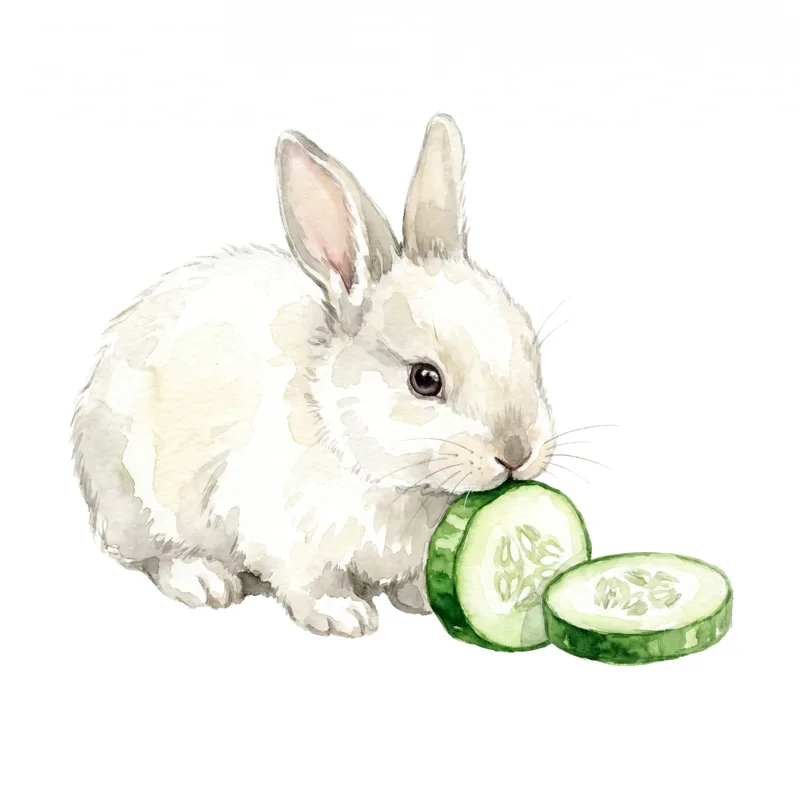
Yes, your rabbit can eat cucumber!
Cucumbers are one of the safest and most refreshing treats you can give a rabbit. They are extremely low in calories, high in water, and easy to prepare. Most rabbits enjoy the mild flavor and satisfying crunch. Serve a few thin slices as a treat 2–3 times a week alongside their main diet of unlimited hay and fresh leafy greens.
Why Cucumber Is a Good Treat for Rabbits
Rabbits have specific dietary needs — unlimited hay should form 80–90% of their diet, supplemented with fresh leafy greens and a small amount of vegetables and fruit. Cucumber fits well into the treat category because it offers:
- Extremely low calories — About 16 calories per 100g, making it one of the lightest treats available
- High water content — At 96% water, cucumber supports hydration, particularly important in summer or for rabbits who do not drink enough
- Mild on the digestive system — Unlike cruciferous vegetables (broccoli, cabbage), cucumber does not cause gas in rabbits
- Enrichment value — The crunchy texture provides mild dental wear and sensory enrichment
- No toxic compounds — Cucumber contains no substances known to be harmful to rabbits
Key Nutritional Facts: Cucumber (per 100g, raw with skin)
- Calories: 16 kcal
- Water: 95.2g
- Fiber: 0.5g
- Sugar: 1.7g
- Vitamin K: 16.4mcg
- Vitamin C: 2.8mg
- Potassium: 147mg
- Magnesium: 13mg
Which Parts of the Cucumber Can Rabbits Eat?
| Part | Safe? | Notes |
|---|---|---|
| Flesh | Yes | Mild flavor; most of the water content |
| Skin / peel | Yes | More fiber than flesh; wash thoroughly |
| Seeds | Yes | Soft and safe; no need to remove |
| Ends (tips) | Yes | Safe; can be slightly more bitter |
| Leaves | Yes | Safe in small amounts; part of the cucumber plant |
| Flowers | Yes | Edible and safe |
The entire cucumber plant is safe for rabbits. The skin is worth keeping — it contains more nutritional value than the watery flesh and adds fiber.
How Much Cucumber to Give
Because cucumber is about 96% water, portion control matters to prevent digestive upset:
| Rabbit Size | Amount Per Serving | Frequency |
|---|---|---|
| Small (under 2 kg / 4.5 lbs) | 1–2 thin slices | 2–3 times per week |
| Average adult (2–4 kg) | 2–3 thin slices | 2–3 times per week |
| Large breed (over 4 kg / 9 lbs) | 3–4 thin slices | 2–3 times per week |
A “thin slice” is approximately one coin-sized round, about 5mm thick.
Always introduce cucumber gradually if your rabbit has not had it before — start with one small piece and monitor their droppings for the next 24 hours. Healthy rabbit droppings should be firm, round, and uniform. Soft, watery, or clumped droppings after introducing cucumber suggest the amount was too large.
Preparing Cucumber for Your Rabbit
- Wash thoroughly — Rinse under cool running water, scrubbing the skin to remove any pesticide residue or surface bacteria
- Choose organic if possible — Conventional cucumber skin may carry pesticide residue; organic removes this concern
- Slice thinly — Coin-sized rounds are easy for rabbits to hold and gnaw on
- Serve fresh or slightly chilled — Room temperature or mildly chilled from the fridge; avoid frozen cucumber as it can cause digestive upset
- Remove after 4 hours — Fresh vegetables left in a rabbit’s enclosure for too long can attract flies and develop bacteria, especially in warm conditions
Cucumber vs. Other Rabbit-Safe Vegetables
How does cucumber compare to other common rabbit treats?
| Vegetable | Calories per 100g | Water Content | Gas Risk | Notes |
|---|---|---|---|---|
| Cucumber | 16 kcal | 96% | None | Best choice for hydration |
| Celery | 16 kcal | 95% | None | High fiber; remove strings for small rabbits |
| Lettuce (romaine) | 17 kcal | 95% | None | Good daily leafy green |
| Carrot | 41 kcal | 88% | None | Higher sugar — treat only |
| Broccoli | 34 kcal | 89% | High | Causes gas; limit strictly |
| Spinach | 23 kcal | 91% | None | High oxalates; rotate with other greens |
| Apple | 52 kcal | 86% | None | Higher sugar; remove seeds |
Cucumber stands out as the most hydrating option with the lowest calorie count — ideal as a frequent treat for rabbits on weight management or for keeping hydration up in warm weather.
Cucumber as a Summer Cooling Treat
Rabbits are highly susceptible to heat stress and heatstroke. Unlike dogs and cats, they cannot pant efficiently and have limited ability to regulate body temperature in hot conditions.
Using cucumber to support hydration in summer:
- Offer 2–3 chilled (not frozen) cucumber slices in the morning and evening on hot days
- Place cucumber in a cool area of the enclosure, not in direct sun
- Always ensure fresh, cool drinking water is available — cucumber supplements hydration but does not replace it
- Watch for signs of heat stress: rapid breathing, lethargy, wet nose, or sprawling flat on the floor
Note: If you suspect heatstroke, move your rabbit to a cool area immediately and contact a veterinarian. Cucumber alone is not sufficient treatment for heatstroke.
Signs Your Rabbit Had Too Much Cucumber
Because of its high water content, too much cucumber causes predictable digestive upset:
- Soft or runny cecotropes — The sticky, grape-cluster droppings rabbits produce should be firm; watery cecotropes indicate excess moisture in the diet
- Diarrhea — Watery droppings separate from cecotropes indicate genuine diarrhea; this can cause rapid dehydration in rabbits and warrants vet attention if it persists beyond 12 hours
- Reduced hay consumption — If your rabbit is filling up on cucumber, they may eat less hay; always remove cucumber after 1–2 hours to prevent this
- Bloating — Rare with cucumber, but visible abdominal distension with reduced droppings needs veterinary attention
If your rabbit has loose droppings after cucumber, skip the cucumber for a few days, increase hay, and reintroduce in a smaller amount.
Living World Teach N Treat Rabbit Toy
Hide slices of cucumber and other vegetables inside this foraging toy to encourage natural enrichment behaviors. Rabbits work to uncover their treats, providing mental stimulation and slowing down treat consumption. Great for indoor rabbits who need more enrichment.
$17.99 View on AmazonAs an Amazon Associate, we earn from qualifying purchases.
Can Bunnies Eat Cucumber?
Yes — “bunny” and “rabbit” are two names for the exact same animal, so every guideline in this article applies whether you call your pet a bunny or a rabbit. Bunnies can eat cucumber safely as an occasional treat: a few thin slices, skin and seeds included, two to three times a week.
The one rule worth repeating for bunnies is portion control. Because cucumber is about 96% water, giving too much is the most common way owners run into trouble — the result is soft cecotropes or outright diarrhea, which dehydrates a bunny quickly. Keep cucumber as a small treat and let unlimited hay do the heavy lifting in the diet.
Can bunnies eat cucumber skin and seeds? Yes to both. The skin is the most nutritious part (more fiber than the flesh), and cucumber seeds are soft and pose no toxicity or choking risk — there is no need to remove them. Just wash the cucumber well first, especially if it is not organic.
Frequently Asked Questions
Can rabbits eat cucumber if they have GI stasis?
No. If your rabbit is experiencing GI stasis (a life-threatening slowdown of gut motility), do not offer cucumber or any fresh vegetables. GI stasis requires veterinary treatment. Focus on encouraging hay consumption and contact your vet immediately if your rabbit stops eating or producing droppings.
My rabbit won’t eat cucumber. Is that normal?
Yes. Rabbits have individual preferences, and some simply do not enjoy cucumber. This is completely fine — there is no nutritional reason to force cucumber on a rabbit who is not interested. Try other safe vegetables like romaine lettuce, celery, or a small piece of carrot instead.
Can cucumber replace water for my rabbit?
No. Cucumber supplements hydration but does not replace the need for constant access to fresh, clean water. Rabbits should always have a water bowl or sipper bottle available regardless of how many hydrating vegetables they consume.
Is English cucumber or regular cucumber better for rabbits?
Both are equally safe. English cucumbers are slightly easier to prepare (thinner skin, no seeds to consider), but the nutritional difference is negligible. Use whichever you have available.
More Foods Your Rabbit Can and Cannot Eat
- Can My Rabbit Eat Grapes? — Safe unlike dogs, but high in sugar
- Can My Rabbit Eat Carrots? — Safe but higher in sugar than most people think
- Can My Rabbit Eat Celery? — Safe and hydrating; remove the stringy fibers
- Can My Rabbit Eat Spinach? — Safe in rotation; high in oxalates if fed daily
- Can My Rabbit Eat Strawberries? — A sweet treat best kept occasional
- Can My Rabbit Eat Broccoli? — Safe in tiny amounts, but causes significant gas
- Can My Rabbit Eat Peas? — The pod is fine, the starchy pea is not
References & Authoritative Sources
The information in this guide is informed by leading veterinary organizations and toxicology resources. For your pet's specific situation, always consult a licensed veterinarian.