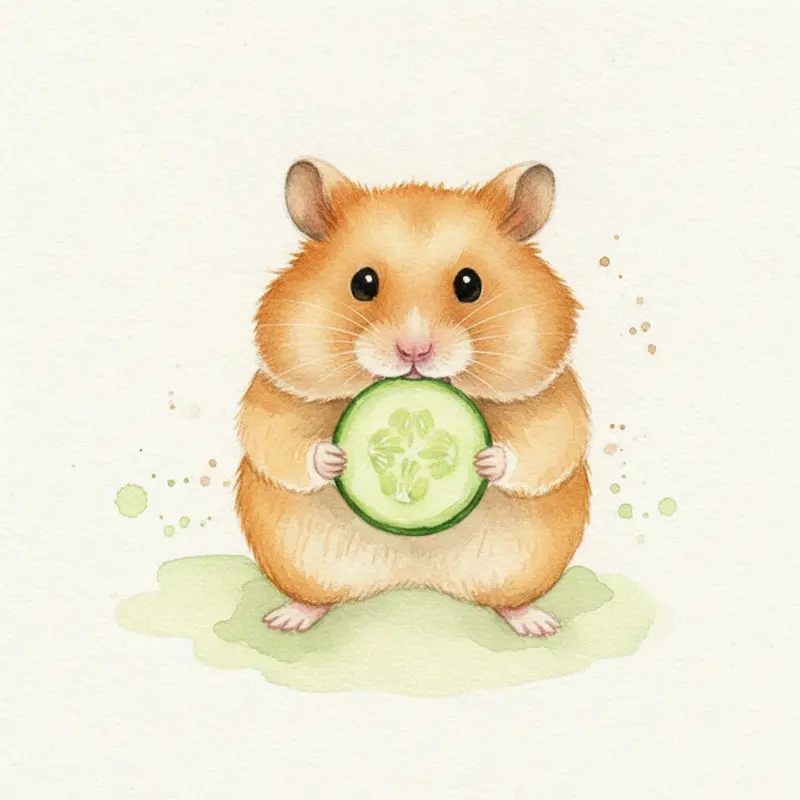
Yes, your hamster can eat cucumber!
Cucumber is safe for hamsters and is one of the smarter vegetable treats you can offer. It is very low in sugar — which makes it suitable even for diabetes-prone dwarf hamsters — and its high water content provides gentle hydration. The main rule is portion control: because cucumber is about 95% water, too much can cause loose stools. Offer a small, thin slice two to three times per week.
Why Cucumber Is a Good Treat for Hamsters
Cucumber sits in a sweet spot for hamster treats: it is genuinely safe, refreshing, and — unlike most fruit — extremely low in sugar. For owners who worry about the sugar in strawberries, banana, or grapes, cucumber is a reassuring alternative that most hamsters happily nibble.
The one thing that makes cucumber different from a dry vegetable like carrot is its very high water content. That water is a benefit in small amounts (it helps hydrate hamsters that do not drink enough) but becomes the main risk if you over-feed. Everything below comes back to that single balance: low sugar is the advantage, high water is the caution.
The benefits of cucumber for hamsters include:
- Very low sugar — At roughly 1.7g of sugar per 100g, cucumber has less than half the sugar of carrot and about a third of the sugar of strawberry. This is why it is one of the few treats safe to offer diabetes-prone dwarf hamsters more regularly.
- Hydration — At about 95% water, cucumber is one of the most hydrating foods you can offer, useful on hot days or for hamsters that drink little.
- Low calorie — At only 15 calories per 100g, cucumber is among the least calorie-dense treats available, so it is unlikely to contribute to weight gain.
- Fiber and nutrients in the skin — The peel holds most of the fiber, vitamin K, and antioxidants, supporting healthy digestion.
- Enrichment — The cool, crisp texture provides variety and something new to explore, which helps break up dietary monotony.
Key Nutritional Facts: Cucumber (per 100g, raw with peel)
- Calories: 15 kcal
- Sugar: 1.7g (very low)
- Fiber: 0.5g
- Vitamin K: 16.4mcg
- Vitamin C: 2.8mg
- Potassium: 147mg
- Magnesium: 13mg
- Water: 95%
- Fat: 0.1g (very low)
How to Prepare Cucumber for Your Hamster
Proper preparation keeps the treat safe and reduces the water risk:
Step 1: Choose a firm, fresh cucumber. Select one that is firm and dark green, without soft spots, mold, or a slimy surface. Fresh cucumber has the best texture and nutrient content.
Step 2: Wash thoroughly. Rinse the cucumber under cool running water, gently rubbing the surface. Cucumbers are often coated in a food-grade wax and may carry pesticide residue on the skin, so washing is important — especially if you plan to leave the peel on.
Step 3: Decide on the skin. The skin is safe and holds most of the fiber and nutrients, so leaving it on (well washed) is ideal. If your cucumber is waxed and not organic, peeling it is a reasonable, more cautious option.
Step 4: Reduce the water for dwarfs (optional). The watery seed core adds extra moisture. For small dwarf hamsters, you can scoop out the seedy center and offer the firmer flesh to lower the diarrhea risk.
Step 5: Cut to the right size. For a Syrian, cut a thin slice about the size of a thumbnail. For a dwarf hamster, cut that in half again. Thin pieces are easier to eat and less likely to be hoarded.
Step 6: Serve fresh and remove leftovers. Offer the piece by hand or in the food dish, and remove any uneaten cucumber within 2-3 hours. Watery vegetables spoil fast in a warm cage and can attract insects.
Portion Sizes by Hamster Species
Hamster species vary widely in size, and cucumber portions should scale accordingly:
| Species | Average Weight | Cucumber Portion | Maximum Frequency |
|---|---|---|---|
| Syrian (Golden) | 120-170g | 1 thin thumbnail-sized slice | 2-3 times per week |
| Campbell’s Dwarf | 30-45g | ½ that amount | 2 times per week |
| Winter White Dwarf | 25-40g | ½ that amount | 2 times per week |
| Roborovski Dwarf | 20-25g | ¼ of a normal slice (a sliver) | 1-2 times per week |
| Chinese | 30-45g | ½ that amount | 2 times per week |
Why watch the water, not the sugar: With most treats, the limiting factor is sugar. With cucumber it is the opposite — the sugar is so low that it is barely a concern, but the 95% water content means over-feeding leads to soft or watery droppings. Because dwarf hamsters have such tiny bodies, a portion that seems small to us can still be a lot of water for them.
Can Specific Hamster Breeds Eat Cucumber?
The portion table gives the numbers, but the most common question owners ask is whether cucumber is safe for their particular breed. All hamsters can eat cucumber, but the right amount — and whether it is a smart choice — depends on the breed.
Can Syrian Hamsters Eat Cucumber?
Yes — Syrians handle cucumber easily. As the largest pet hamster (120–170g), a Syrian can enjoy a thin, thumbnail-sized slice two to three times a week as a hydrating, low-sugar treat. Remove any slice your hamster pouches rather than eats, since watery vegetables spoil quickly in a food stash and can turn moldy.
Can Russian Dwarf Hamsters Eat Cucumber?
Yes — and this is where cucumber really shines. “Russian dwarf” refers to Campbell’s and Winter White hamsters, which are genetically prone to diabetes. Because cucumber is one of the lowest-sugar treats available, it is a far safer choice for them than fruit. Offer a piece about half the size you’d give a Syrian, up to twice a week, and keep an eye on their droppings, since their tiny bodies are sensitive to the high water content. For a diabetic or overweight Russian dwarf, low-sugar vegetables like cucumber and bell pepper are exactly the kind of treat to favor over sugary fruit.
Can Roborovski Hamsters Eat Cucumber?
Yes, but think sliver. Roborovskis are the smallest hamster (20–25g), so even a “small” slice is a large amount of water relative to their body. Offer a sliver no bigger than a quarter of a normal slice, once or twice a week at most, and scoop out the watery seed core first. Their tiny size makes careful portioning more important than for any other breed.
Can Chinese Hamsters Eat Cucumber?
Yes. Chinese hamsters (30–45g) can have about half a Syrian portion, up to twice a week. Like the Russian dwarfs, they benefit from cucumber’s low sugar, and the same watery-stool caution applies — introduce it slowly and watch the droppings.
The Watery Stool Warning
The single most important thing to know about cucumber is that too much can cause diarrhea, and diarrhea is genuinely dangerous for a hamster.
Because hamsters are so small, they dehydrate very quickly. A bout of watery droppings can drain fluids faster than the hamster can replace them, leaving it weak and at risk. This is why the low sugar in cucumber does not make it a “free” food — the water content sets a firm ceiling on how much is safe.
How to keep cucumber safe:
- Stick to a small, thin slice at the frequency in the table above
- Introduce cucumber gradually the first time (see below)
- Scoop out the seedy center for dwarf hamsters
- Stop feeding cucumber immediately if droppings become soft or watery
- Make sure fresh water is always available so hydration stays balanced
If soft droppings appear, remove all fresh vegetables and fruit for a few days and offer only your hamster’s normal dry food and hay until stools firm up. If diarrhea is severe, continues for more than a day, or comes with lethargy, contact a veterinarian promptly.
Can Hamsters Eat Cucumber Skin and Seeds?
Yes to both:
- Skin (peel) — The skin is safe and actually the most nutritious part, holding most of the fiber, vitamin K, and antioxidants. Leaving it on is ideal, provided the cucumber is washed thoroughly. If the cucumber is waxed and not organic, peeling is a fine, more cautious choice.
- Seeds — Cucumber seeds are soft and harmless, so there is no need to remove them for safety. The only reason to scoop out the watery seed core is to reduce moisture for small dwarf hamsters prone to loose stools.
Cucumber has no toxic parts for hamsters — unlike apple seeds (cyanide) or the pits of stone fruit — so the whole vegetable is safe. The only judgment call is the peel-versus-wax question and the water content.
Cucumber vs. Other Vegetable Treats for Hamsters
How does cucumber compare with other common hamster vegetables?
| Vegetable | Sugar (per 100g) | Water | Best For |
|---|---|---|---|
| Cucumber | 1.7g (very low) | 95% | Hydration, diabetes-prone dwarfs |
| Carrot | 4.7g | 88% | Vitamin A, dental wear |
| Broccoli | 1.7g | 89% | Vitamin C, fiber |
| Bell pepper | 4.2g | 92% | Vitamin C, low-cal crunch |
| Cooked plain pumpkin | 2.8g | 92% | Fiber, gentle on digestion |
Cucumber’s standout traits are its very low sugar and high water — making it best thought of as a hydrating treat rather than a nutrient-dense one. For that reason it pairs well in a rotation with a more nutritious, drier vegetable like carrot or broccoli.
Cucumber and the Hamster Cheek Pouch
Hamsters are natural hoarders and will often pouch a cucumber slice to carry back to their food stash instead of eating it on the spot. This is normal, but it creates a specific problem with watery vegetables:
- Cucumber’s high moisture makes it rot faster than dry foods once stashed
- Moldy food in the stash can make a hamster seriously ill
- Damp, sugary-smelling scraps can attract insects
How to manage it: offer cucumber during supervised out-of-cage time, or use thin slices that are easier to eat than to carry, and check your hamster’s food stash every 2-3 days to remove any perishable items before they spoil.
Building a Balanced Hamster Diet
Cucumber is a treat, not a staple — here is how it fits into the bigger picture:
| Food Category | Percentage of Diet | Examples |
|---|---|---|
| Quality pellet or seed mix | 80-85% | Lab blocks, Higgins Sunburst, Mazuri |
| Fresh vegetables | 10-15% | Cucumber, carrot, broccoli, bell pepper |
| Fresh fruits (treats) | 5% or less | Strawberry, blueberry, apple, banana |
| Protein treats | Occasional | Mealworm, boiled egg, plain tofu |
The foundation of your hamster’s diet should always be a high-quality commercial hamster food, with unlimited timothy hay for fiber and dental wear. Fresh vegetables like cucumber are healthy supplements, but they are not nutritionally complete on their own.
Kaytee Fiesta Hamster Food
A complete daily diet formulated specifically for hamsters, providing balanced nutrition with a mix of grains, seeds, and dehydrated fruits and vegetables. When your hamster has a solid nutritional foundation, fresh treats like cucumber become a safe hydrating bonus rather than a dietary necessity.
$12.99 View on AmazonAs an Amazon Associate, we earn from qualifying purchases.
Introducing Cucumber for the First Time
If your hamster has never eaten cucumber before, introduce it gradually:
Day 1: Offer a tiny piece — about half the size of a pea. Watch your hamster eat it and observe for the next 12-24 hours.
Day 2-3: Check the droppings. They should stay firm, dry, and pellet-shaped. Any softening is a sign the portion was too much or too watery.
Day 4-5: If there was no digestive upset, offer a slightly larger piece.
Week 2 onward: If all is well, work up to the full recommended slice for your hamster’s species, keeping to the 2-3 times per week maximum.
Warning Signs to Watch For
Stop offering cucumber and reassess if you notice any of the following:
- Soft or watery droppings — The most common sign of too much cucumber; remove fresh foods until stools firm up
- A wet or dirty tail area — Can indicate diarrhea, which is a serious emergency in hamsters
- Lethargy or reduced appetite — Warrants a break from all treats and, if it persists, a vet visit
- Bloating or discomfort — Reduce portion size and frequency
Most hamsters tolerate small amounts of cucumber with no trouble at all — these signs simply mean the portion was too large or too frequent.
Frequently Asked Questions
Can baby hamsters eat cucumber?
Baby hamsters (pups) should not be offered cucumber until they are fully weaned and eating solid food on their own, usually around 3-4 weeks of age. Even then, start with an extremely tiny piece. Young hamsters have very sensitive digestive systems, and cucumber’s water content makes loose stools more likely in the very young.
Can hamsters eat cucumber every day?
It is best not to give cucumber every day. Even though it is low in sugar, the high water content can lead to loose stools if fed too often. Two to three times a week for a Syrian, and up to twice a week for dwarf breeds, is a safe frequency. Rotate it with drier vegetables like carrot or broccoli.
Is cucumber good for diabetic hamsters?
Cucumber is one of the better vegetable options for diabetic or diabetes-prone hamsters because it is very low in sugar. It is a much safer treat than fruit for Campbell’s and Winter White dwarfs. Still keep portions small due to the water content, and discuss any diabetic hamster’s diet with an exotic-pet veterinarian.
Can hamsters eat pickled cucumber or gherkins?
No. Pickled cucumbers and gherkins are soaked in salt, vinegar, and often sugar and spices, all of which are harmful to hamsters. Only offer plain, fresh, raw cucumber — never pickled, seasoned, or brined versions.
My hamster ignored the cucumber. Is that normal?
Yes. Some hamsters love cucumber and others are indifferent to its mild, watery flavor. If your hamster is not interested, that is perfectly fine — there is no food a hamster must eat, and other safe vegetables like carrot or broccoli may appeal more.
More Foods Your Hamster Can and Cannot Eat
Curious about other foods for your hamster? Check out our other hamster food safety guides:
- Can My Hamster Eat Carrots? — A crunchy, vitamin-A-rich vegetable treat
- Can My Hamster Eat Strawberries? — A juicy safe snack in moderation
- Can My Hamster Eat Cheese? — A tiny treat with big rules
- Can My Hamster Eat Bananas? — A potassium-rich mini treat
- Can My Hamster Eat Apples? — Safe flesh, but the seeds are toxic
- Can My Hamster Eat Lettuce? — Romaine yes, iceberg no
- Can My Hamster Eat Peas? — Protein-rich, but count the carbs
- Can My Hamster Eat Rice? — Plain grains only, and tiny
References & Authoritative Sources
The information in this guide is informed by leading veterinary organizations and toxicology resources. For your pet's specific situation, always consult a licensed veterinarian.