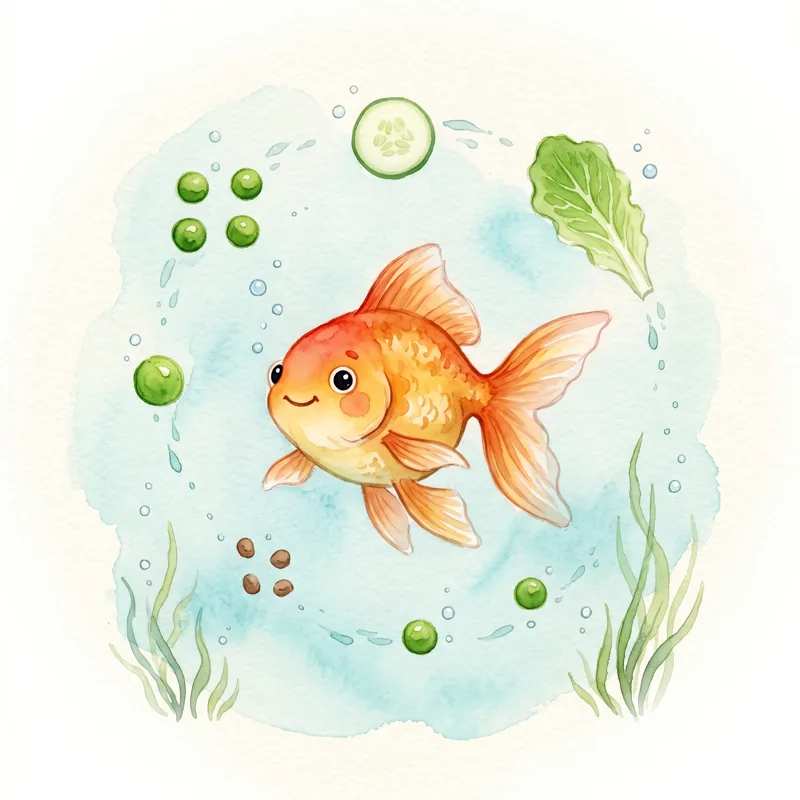
Goldfish are omnivores with a hearty appetite — but their compressed digestive tract and unique anatomy mean what you feed them matters more than for most aquarium fish. A poor diet is the leading cause of goldfish swim bladder disorder, constipation, and shortened lifespan. The good news: a balanced goldfish diet is simple to assemble once you know what they need.
This complete guide covers everything goldfish can (and cannot) eat — staple pellets, vegetables, protein sources, treats, foods to avoid, and the feeding schedule that keeps fancy and common goldfish healthy for 10–20+ years.
Goldfish Diet at a Glance
| Food Category | Examples | Frequency |
|---|---|---|
| Staple | High-quality sinking goldfish pellets | Daily, 1–2× per day |
| Vegetables | Blanched peas, cucumber, romaine lettuce, zucchini, spinach | 2–3× per week |
| Protein | Bloodworms, brine shrimp, daphnia | 1–2× per week |
| Treats | Shelled peas (also for swim bladder), small fruit pieces | Occasional |
| Avoid | Bread, crackers, salted foods, dairy, processed human food | Never |
| Fasting day | No food at all | 1× per week |
What Goldfish Eat (5-Step Daily Diet)
The snippet-ready goldfish feeding routine:
- Staple meal — Feed a high-quality sinking goldfish pellet 1–2 times per day. Only as much as they can consume in 1–2 minutes.
- Add vegetables — 2–3 times per week, offer blanched peas, cucumber, romaine lettuce, or zucchini. Remove any uneaten pieces within 12 hours.
- Rotate protein — Once or twice a week, swap a meal for frozen or freeze-dried bloodworms, brine shrimp, or daphnia.
- Fast one day a week — Skip food completely one day per week to give the digestive system a break and prevent constipation.
- Watch the waste — Long, stringy, white feces signal overfeeding or low-quality food. Switch to vegetables and pellets with more fiber.
That’s it. Goldfish thrive on simple, varied, high-fiber diets — not on rich or processed foods.
Goldfish Are Omnivores, Not Insectivores
Many fishkeepers feed goldfish like they’re little tropical fish — too much protein, too little fiber. This is a major cause of constipation and swim bladder disease.
In the wild, goldfish (descended from Asian wild carp) eat a varied diet of:
- Aquatic plants and algae (the bulk of their diet)
- Insect larvae and small crustaceans
- Detritus and biofilm
- Tiny zooplankton
The lesson for captive goldfish: plant matter and fiber should form the majority of their diet, with protein as a smaller component. This is the opposite of how betta fish or carnivorous cichlids should be fed.
Key biological factors that shape the goldfish diet:
- No true stomach — Goldfish digest food in a long intestinal tract. Slow-moving high-fat food clogs them up.
- Constant grazing — Goldfish are designed to nibble throughout the day, not eat one large meal.
- Compressed body shape (fancy varieties) — Orandas, ranchus, and ryukins have especially short, twisted digestive tracts that make them prone to constipation and swim bladder disorder.
- Bottom orientation — Goldfish naturally feed by rooting through substrate, not gulping at the surface.
Staple Foods: Pellets and Flakes for Goldfish
The foundation of a goldfish diet is a high-quality, goldfish-specific commercial food.
Sinking Pellets (Best Choice)
Sinking pellets are the gold standard for goldfish. Floating pellets cause goldfish to gulp air at the surface, which contributes to swim bladder issues — especially in fancy varieties.
What to look for in a goldfish pellet:
- Listed as goldfish-specific (not generic “tropical fish food”)
- 35–40% protein maximum — higher levels are not appropriate for goldfish
- High vegetable content — wheat germ, spirulina, and plant-based ingredients
- Includes prebiotics or probiotics for digestive health
- Free from fish meal as the first ingredient — quality whole fish or krill is better
- Sinking rather than floating
Trusted goldfish pellet brands:
- Hikari Goldfish (sinking)
- Saki-Hikari Goldfish
- Repashy Soilent Green (gel food)
- Northfin Goldfish Formula
- Omega One Goldfish (sinking)
Pellet size matters: Use small pellets for young or small goldfish, and pre-soak pellets for fancy goldfish to reduce gas formation in their digestive tract.
Flakes (Acceptable Alternative)
Flakes work for community tanks and small goldfish but have downsides for adult or fancy goldfish:
- Tend to float, encouraging air gulping
- Crumble into small pieces that pollute water
- Less nutritionally dense per volume
If you use flakes, soak them for 30 seconds before feeding to make them sink and reduce air intake.
Gel Foods (Premium Option)
Gel foods like Repashy Soilent Green are made from whole-food ingredients you mix with water and refrigerate. They’re nutrient-dense, low in fillers, and excellent for fancy goldfish. They take more effort to prepare but produce noticeably better fish health and color.
Vegetables for Goldfish
Vegetables should be a major component of a goldfish diet — far more important than for most other aquarium fish.
Best Vegetables for Goldfish
| Vegetable | Best For | Preparation |
|---|---|---|
| Shelled peas | Swim bladder + constipation #1 remedy | Boil 30s, shell, mash |
| Cucumber | Daily grazing | Slice ½", blanch 1–2 min |
| Romaine lettuce | Vitamins A & K | Blanch 15–30s |
| Zucchini | Easy, well-loved | Slice ¼", blanch 1–2 min |
| Blanched spinach | Iron + folate | Blanch briefly, feed sparingly |
| Broccoli florets | Vitamin C | Blanch until soft |
| Sweet potato (cooked) | Vitamins, fiber | Boil until very soft |
Vegetables to Avoid
- Iceberg lettuce — 95% water, no nutrition, decomposes fast
- Raw potato — Contains solanine, toxic to fish
- Onion / garlic — Toxic in any form
- Avocado — Persin is toxic
- Citrus fruits — Acidic, can disrupt water chemistry
- Tomato leaves and stems — Contain tomatine
How to Feed Vegetables to Goldfish
- Blanch first — Drop in boiling water for 1–2 minutes, then cool in cold water. Softens flesh, removes pesticides, helps it sink.
- Cut to size — Half-inch slices for adult goldfish, smaller for juveniles.
- Weigh down — Use a veggie clip, fork, or aquarium-safe rock so vegetables sink.
- Remove within 12 hours — Decomposing vegetables cause ammonia spikes.
Protein for Goldfish
Protein supplements should be occasional, not daily. Too much protein causes goldfish constipation and ammonia spikes from undigested waste.
Best Protein Sources
- Frozen bloodworms — Goldfish favorite. Thaw before feeding. Once or twice per week max.
- Frozen brine shrimp — Excellent enrichment food. High in carotenoids that enhance color.
- Frozen daphnia — Acts as a natural laxative; great for digestive health.
- Mysis shrimp — High protein, less likely to cause bloat than bloodworms.
- Black soldier fly larvae — High calcium, balanced nutrition.
Protein Foods to Limit or Avoid
- Live tubifex worms — High disease risk; only use if from a reliable source.
- Beef heart — Too fatty for goldfish. Avoid.
- Mealworms — Hard exoskeleton; difficult for goldfish to digest.
- Live feeder fish — Disease vector; provides no nutritional advantage over frozen foods.
Foods to NEVER Feed Goldfish
These foods cause real harm to goldfish health:
- Bread, crackers, chips — Expand in the gut, cause bloating and constipation. See Can Fish Eat Bread? and Can Fish Eat Crackers? for details.
- Salted or seasoned anything — Salt causes osmotic stress and damages internal organs.
- Dairy products — Goldfish cannot digest lactose.
- Fatty meats (beef, pork, sausage) — Indigestible fat layers cause organ damage.
- Sugary or processed human snacks — No nutritional value, destroys water quality.
- Dog or cat food — Wrong protein-to-fiber ratio entirely.
- Citrus — Disrupts pH balance.
- Avocado — Persin is toxic to fish.
Common myth: “A little of [human food] won’t hurt.” It does. Even small amounts of bread or salted food cause real digestive damage in goldfish over time.
Goldfish Feeding Schedule
A simple weekly routine that keeps goldfish healthy:
| Day | Meal 1 | Meal 2 |
|---|---|---|
| Monday | Sinking pellets | Blanched cucumber |
| Tuesday | Sinking pellets | Sinking pellets |
| Wednesday | Frozen bloodworms | Sinking pellets |
| Thursday | Sinking pellets | Romaine lettuce |
| Friday | Sinking pellets | Sinking pellets |
| Saturday | Shelled peas | (only) |
| Sunday | Fasting day | — |
Portion guidance: A goldfish’s stomach is about the size of its eye. Feed only what they consume in 1–2 minutes. Stop when they slow down — not when they “look full” (they never do).
Diet for Fancy Goldfish vs Common Goldfish
Fancy goldfish (orandas, ranchus, ryukins, fantails, black moors, telescope eyes) need extra digestive support due to their compressed bodies:
- More vegetables (3–4 times per week instead of 2–3)
- Pre-soaked pellets to reduce gas
- Sinking foods only — never floating
- Weekly pea feeding as a digestive cleanse
- Strict fasting day every week
Common (single-tail) goldfish (commons, comets, shubunkins) are heartier:
- Standard feeding schedule works fine
- Can handle larger meals
- Less prone to swim bladder issues but still benefit from vegetables
Diet for Goldfish with Swim Bladder Disorder
Swim bladder disorder is the most common goldfish illness. If your goldfish is floating upside down, sinking, or struggling to maintain depth, the diet protocol is:
- Fast for 24 hours — No food at all.
- Feed only shelled blanched peas for the next 2–3 days. The fiber acts as a laxative.
- Reintroduce normal diet gradually starting on day 4, with smaller portions than usual.
- Switch to sinking pellets permanently if you were using floating ones.
- Pre-soak pellets for at least 30 seconds before feeding from now on.
If symptoms persist after 3 days of pea treatment, the cause may be bacterial or structural and needs veterinary intervention.
Diet for Goldfish with Constipation
Constipation in goldfish shows up as long stringy white feces, loss of appetite, or visible bloating.
Treatment:
- Fast 24 hours
- Feed peas + daphnia for 2–3 days
- Increase fiber permanently — more vegetables, less protein
- Reduce or eliminate freeze-dried foods (they expand in the gut)
Common Goldfish Feeding Mistakes
Mistake 1: Overfeeding. The single biggest cause of goldfish death. Goldfish cannot say no to food. Feed only what they can eat in 1–2 minutes.
Mistake 2: Floating pellets. Encourages air gulping → swim bladder issues. Switch to sinking.
Mistake 3: All protein, no vegetables. Goldfish are not bettas. They need fiber.
Mistake 4: Skipping the fasting day. A weekly fast prevents digestive disease.
Mistake 5: Tropical fish flakes. Wrong protein ratio for goldfish. Use goldfish-specific food.
Mistake 6: Treating “begging” as hunger. Goldfish always look hungry. They aren’t.
Mistake 7: Feeding bread. Even tiny amounts cause real problems. See Can Fish Eat Bread?.
Frequently Asked Questions
Can goldfish eat fruit?
In tiny amounts, yes — small pieces of de-seeded apple, watermelon, or orange are safe occasional treats. Avoid citrus and never feed seeds. Fruit should be a rare treat, not a regular food.
Can baby goldfish (fry) eat the same diet?
No. Goldfish fry need infusoria, baby brine shrimp, and finely crushed fry food for their first 2–4 weeks. After that, they can transition to crushed adult pellets.
Should I feed live food?
Frozen and freeze-dried foods are safer than live foods, which carry parasite and disease risk. The only exceptions are home-cultured brine shrimp and daphnia where you control the source.
Can goldfish eat fish food meant for tropical fish?
Not as a staple. Tropical fish food has too much protein and not enough fiber for goldfish. Use goldfish-specific food.
How do I know if I’m overfeeding?
Signs of overfeeding include cloudy water, algae blooms, long trailing feces, lethargic fish, and ammonia readings above 0 ppm. Reduce portions immediately and run a partial water change.
Can goldfish and tropical fish share food?
In a mixed tank, choose a sinking goldfish-specific food. Tropical fish can eat goldfish food, but goldfish should not rely on tropical fish food long-term.
More Goldfish & Fish Food Guides
- Can My Fish Eat Peas? — The #1 swim bladder remedy
- Can My Fish Eat Cucumber? — Goldfish & pleco favorite
- Can My Fish Eat Lettuce? — Romaine yes, iceberg no
- Can My Fish Eat Bread? — Why bread is harmful
- Can My Fish Eat Crackers? — Why processed foods destroy water quality
References & Authoritative Sources
The information in this guide is informed by leading veterinary organizations and toxicology resources. For your pet's specific situation, always consult a licensed veterinarian.