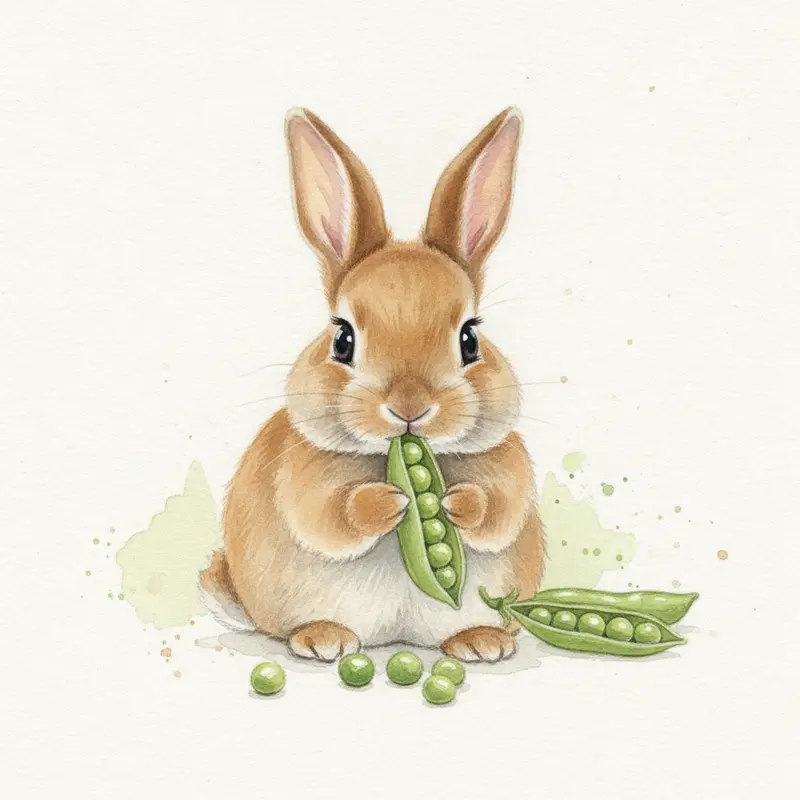
Caution: peas requires care for your rabbit.
Here's the part most food lists get wrong: for a rabbit, the **pea and the pod are not the same food**. The green pea itself is a starchy legume seed, and rabbits are built to run on high-fiber, low-starch forage — so peas sit on the "avoid as a regular food" list of most rabbit-care authorities. A stray pea won't poison a healthy adult, but the **pods, plants, and leaves** are the genuinely safe, rabbit-friendly parts. Offer a little washed pea pod or pea greens as an occasional vegetable, skip the starchy peas, and never feed dried, canned, or seasoned peas.
Can Bunnies Eat Peas?
Yes and no — and the distinction is the whole point of this article. “Bunny” and “rabbit” are the same animal, so the same rules apply either way: the starchy green pea is best left out of the diet, while the pea pod, pea plant, and pea leaves are safe in moderation.
If you came here because a recipe, a pellet mix, or another website told you peas are a fine rabbit treat, this guide explains why the vet-correct answer is more careful than that — and how to share the pea plant with your bunny the right way.
Why Peas Themselves Are a Caution for Rabbits
A pea looks like a harmless little vegetable, but botanically it is a legume seed — the plant’s starchy energy store. That one fact is what puts peas at odds with how a rabbit’s body works.
Rabbits are hindgut fermenters. They digest their food in a large organ called the cecum, home to a delicately balanced population of bacteria that break down fiber. That whole system is tuned for one kind of diet: lots of fiber, very little starch or sugar. Hay and leafy greens fit perfectly. Starchy, carbohydrate-dense foods do not.
When too much starch slips past the small intestine and reaches the cecum, it can feed the wrong bacteria. The healthy fiber-fermenting flora get crowded out, gas-producing and harmful bacteria multiply, and the result can be bloating, soft stool, cecal dysbiosis, and — in the worst case — GI stasis, a condition where the gut slows or stops. GI stasis is a genuine emergency in rabbits and can be fatal if untreated.
Peas are not the most dangerous food a rabbit could eat, and a single pea is not going to cause a crisis in a healthy adult. But because they bring exactly the thing a rabbit’s gut handles worst — concentrated starch — reputable rabbit-welfare organisations commonly list peas, beans, and other legumes among the foods to avoid. There is simply no nutritional reason a rabbit needs them, and better, safer vegetables are easy to offer instead.
Key Nutritional Facts: Green peas (per 100g, raw)
- Calories: 81 kcal
- Carbohydrate: 14g (high for a rabbit food)
- Starch: ~4-5g (the main concern)
- Sugar: 5.7g (moderate)
- Fiber: 5.7g
- Protein: 5.4g (high for a vegetable)
- Calcium: 25mg
- Water: 79%
- Fat: 0.4g
Compare that to the vegetables rabbits should eat — leafy greens that are almost all fiber and water with barely any starch — and you can see why the pea is the odd one out.
The Good News: Pea Pods, Plants, and Leaves Are Safe
Here is the nuance that generic food lists miss. The problem is the seed, not the plant. The rest of the pea plant is low in starch and high in fiber — exactly what a rabbit wants.
- Pea pods (mangetout / snow peas and sugar snap pods) — The soft, edible pod is mostly fiber and water, with far less starch than the peas inside. A small, washed piece is a perfectly good occasional vegetable. (For sugar snap and garden pods that contain developed peas, it’s fine if a pea or two comes along — just don’t make a pile of peas the treat.)
- Pea shoots and pea leaves — The tender leafy tips and foliage of the pea plant are a genuinely good green, safe to include in the daily leafy-green rotation.
- Pea plant foliage from the garden — If you grow peas (and haven’t sprayed them), the leaves and vines are one of the best parts to share, washed, with your rabbit.
So if your rabbit loves nosing at the pea plant, you don’t have to say no — you just steer them toward the pod and the leaves rather than a bowl of shelled peas.
How to Offer Pea Pods and Greens Safely
If you’d like to share the rabbit-friendly parts of the pea plant, here’s how to do it without upsetting the gut:
Step 1: Choose fresh, plain pods or greens. Fresh snow pea or sugar snap pods, pea shoots, or washed pea-plant leaves. No cooked, canned, dried, or seasoned peas of any kind.
Step 2: Wash thoroughly. Rinse under cool water to remove pesticide residue, especially for anything grown commercially.
Step 3: Offer a small piece. For pods, a single small pod or a half-inch piece is plenty. For greens, a small handful mixed into the usual leafy greens.
Step 4: Introduce one new food at a time. Don’t add pea greens the same day you try another new vegetable — you want to be able to spot the cause if droppings change.
Step 5: Watch the droppings for 24-48 hours. Healthy rabbit droppings are round, dry, and uniform. Soft stool, fewer droppings, or mushy cecotropes mean it didn’t agree with your rabbit — stop and go back to hay.
Step 6: Remove uneaten fresh food. Take out anything not eaten within a few hours so it can’t spoil in the enclosure.
How Much, and How Often?
Pea pods and greens count toward the fresh-vegetable share of the diet, not as an extra on top. A good rule of thumb for an adult rabbit is around 1 cup of fresh leafy greens and vegetables per 2 lb (about 1 kg) of body weight per day, split across a variety of greens — pea pods or shoots being just one small part of that mix, a few times a week.
| Part of the pea | Safe for rabbits? | How to offer |
|---|---|---|
| Green peas (the seed) | Avoid as a regular food | A stray pea is not an emergency, but don’t offer bowls of peas |
| Fresh pea pods (snow / sugar snap) | Yes, in moderation | Small washed piece, a few times a week |
| Pea shoots / microgreens | Yes | Small amount in the daily green rotation |
| Pea plant leaves / foliage | Yes | Washed, unsprayed, as part of mixed greens |
| Dried or split peas | No | Avoid entirely (see below) |
| Canned or seasoned peas | No | Salt and additives are harmful |
The golden rule underneath all of this: hay should make up 80-85% of a rabbit’s diet, all day, every day. Fresh greens are the next slice, treats are tiny, and starchy foods like peas are not a necessary part of the picture at all.
Why Dried Peas in Muesli Mixes Are a Problem
If you’ve seen peas in a rabbit food, it was almost certainly a dried whole or split pea in a muesli-style mix — the colourful blends of flakes, grains, seeds, and dried bits. These are worth a specific warning.
Dried peas are concentrated starch, even more so than fresh ones, because the water is gone. And in a muesli mix they create a behaviour problem called selective feeding: rabbits pick out the sweet, starchy, tasty bits (like peas, corn, and flakes) and leave the fibrous pellet and hay behind. Over time that leads to:
- An unbalanced, low-fiber diet that undermines gut health.
- Obesity, from all those extra carbohydrates.
- Dental disease, because the rabbit isn’t doing the constant hay-chewing that wears their ever-growing teeth down.
This is why most veterinarians and rabbit charities now recommend moving away from muesli mixes entirely in favour of a plain, uniform pelleted food plus unlimited hay. If your rabbit’s food contains dried peas, that’s a good reason to switch.
Oxbow Essentials Adult Rabbit Food
A uniform, timothy-based pellet with no muesli-style loose bits for your rabbit to pick through — so there are no dried peas or sugary pieces to selectively feed on. Paired with unlimited hay, a plain pellet like this keeps the diet high-fiber and low-starch, exactly the way a rabbit's gut is built to work.
$14.99 View on AmazonAs an Amazon Associate, we earn from qualifying purchases.
Better Vegetables to Offer Instead
If you were reaching for peas as a treat, these rabbit-safe vegetables and greens do the job without the starch:
- Leafy greens — romaine lettuce, green leaf lettuce, bok choy, and herbs like cilantro, basil, and parsley make up the backbone of the fresh portion.
- Celery — crunchy and low in sugar (cut small to break the strings — see our celery guide).
- Cucumber — hydrating and very low in sugar.
- Carrot tops — the leafy greens are better everyday fare than the starchy root.
- Broccoli — in small amounts (introduce slowly, as it can cause gas in some rabbits).
- Pea pods and pea shoots — the one rabbit-friendly way to enjoy the pea plant.
Rotating several of these keeps the diet varied and interesting without ever needing a starchy legume.
What to Do If Your Rabbit Ate Too Many Peas
Found your rabbit tucking into a bowl of shelled peas, or dropped a handful on the floor? Don’t panic — here’s how to handle it:
- Remove the remaining peas and any other starchy or sugary food.
- Offer unlimited fresh hay — getting fiber moving through the gut is the single most important thing.
- Make sure fresh water is always available.
- Hold off on all other treats and fresh foods for the next day or two while the gut settles.
- Watch the droppings and appetite closely for 24-48 hours.
Call a rabbit-savvy vet right away if your rabbit:
- Stops eating or stops producing droppings — the classic early sign of GI stasis.
- Sits hunched, grinds its teeth in pain, or presses its belly to the floor.
- Looks or feels bloated.
- Has watery diarrhea (different from soft cecotropes and more serious).
In rabbits, a gut that goes quiet is an emergency, not a “wait and see” — the sooner it’s treated, the better the outcome.
Building a Healthy Rabbit Diet
Peas are a useful illustration of the one principle that governs everything a rabbit eats: fiber first, starch last.
| Food Category | Percentage of Diet | Examples |
|---|---|---|
| Grass hay (unlimited) | 80-85% | Timothy, orchard grass, meadow hay |
| Fresh leafy greens & vegetables | 10-15% | Romaine, herbs, pea pods, celery, cucumber |
| Quality pellets | ~5% | Plain timothy-based pellet (not muesli) |
| Treats (fruit, etc.) | Under 5% | A thin slice of apple or a berry, rarely |
Notice there is no column where starchy peas belong. Hay does the heavy lifting; greens add variety and nutrients; pellets top up the gaps; treats are tiny. A pea pod or some pea leaves slot neatly into the greens row — the peas themselves simply don’t have a home in this picture.
Introducing New Greens the Right Way
Any time you add a new green — pea shoots and pods included — go slowly:
Day 1: Offer a small piece of one new food only. Watch for the next 24 hours.
Day 2-3: Check the droppings. They should stay round, dry, and plentiful. Any softening, mushy cecotropes, or a drop in output means stop.
Day 4 onward: If all is well, you can keep the new green in the rotation at a small, regular amount.
This one-food-at-a-time approach means that if something ever does disagree, you’ll know exactly what caused it.
Frequently Asked Questions
Can rabbits eat frozen or canned peas?
Frozen plain peas are still the starchy seed, so the same “avoid the pea itself” advice applies — a stray thawed pea is not an emergency, but don’t make them a treat. Canned peas are worse: they sit in salted water, and the added sodium is harmful to rabbits. Neither is a food to offer deliberately.
Are peas poisonous to rabbits?
No, green peas are not toxic or poisonous to rabbits in the way that, say, chocolate or avocado is. The concern is different: peas are a starchy legume that doesn’t suit a rabbit’s fiber-dependent digestive system, so they’re a “best avoided” food rather than a “dangerous” one. A pea eaten by accident is very unlikely to harm a healthy adult rabbit.
Can rabbits eat chickpeas, lentils, or beans?
No. Like peas, chickpeas, lentils, and beans are starchy, high-protein legumes that are poorly suited to a rabbit’s gut and are commonly on the avoid list. They can cause gas and digestive upset and offer nothing a rabbit’s diet needs. Stick to hay and leafy greens.
My rabbit loves peas — is a little really a problem?
A single pea now and then is unlikely to harm a healthy adult rabbit, so there’s no need to feel guilty about the occasional one. The issue is making peas a regular treat, or offering more than a token amount — that’s when the starch load starts to matter. If your rabbit enjoys the pea plant, redirect that enthusiasm to pea pods and pea leaves, which you can offer with a clear conscience.
Why do some websites say peas are fine for rabbits?
Many general pet-food lists treat every vegetable the same and don’t distinguish a starchy legume seed from a leafy green. Rabbit-specialist vets and welfare charities are more cautious, because they focus on the cecal fermentation system that starch disrupts. When advice conflicts, it’s safest to follow the rabbit-specific, fiber-first guidance.
More Foods Your Rabbit Can and Cannot Eat
Curious about other foods for your rabbit? Check out our other rabbit food safety guides:
- Can My Rabbit Eat Celery? — Safe, but watch the stringy fibers
- Can My Rabbit Eat Cucumber? — A hydrating, low-sugar vegetable
- Can My Rabbit Eat Carrots? — The tops beat the starchy root
- Can My Rabbit Eat Lettuce? — Romaine yes, iceberg no
- Can My Rabbit Eat Broccoli? — Fine in small amounts, introduce slowly
- Can My Rabbit Eat Spinach? — Okay occasionally, watch the oxalates
- Can My Rabbit Eat Apples? — Safe flesh, but never the seeds
- Can My Rabbit Eat Bananas? — A sugary treat for rare occasions
- Can My Rabbit Eat Strawberries? — A sweet treat in tiny amounts
- Can My Rabbit Eat Grapes? — Safe, but very high in sugar
References & Authoritative Sources
The information in this guide is informed by leading veterinary organizations and toxicology resources. For your pet's specific situation, always consult a licensed veterinarian.