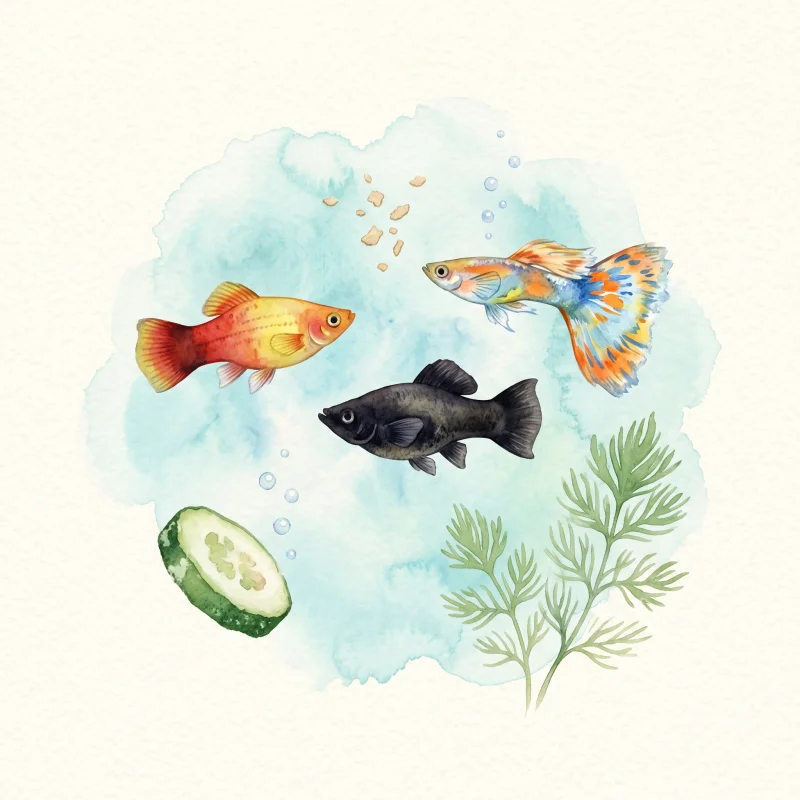
Yes, your livebearers can eat a varied omnivore diet!
**Livebearers — guppies, mollies, platies, swordtails, and endlers — are omnivores that lean toward herbivory.** The daily staple should be a high-quality flake or micro pellet with at least 35% protein and visible plant ingredients. Supplement 2–3 times per week with blanched vegetables (especially for mollies, which are the most herbivorous) and 1–2 times per week with frozen or live protein. **Fast one day per week** to prevent constipation — the most common health issue in livebearers.
Livebearer Diet at a Glance
| Food Category | Examples | Frequency |
|---|---|---|
| Staple | High-quality flake or micro pellet (35–45% protein) | Daily, 1–2× per day |
| Vegetables | Blanched cucumber, zucchini, spinach, shelled peas, romaine | 2–3× per week (3–4× for mollies) |
| Protein | Frozen daphnia, brine shrimp, bloodworms, mosquito larvae | 1–2× per week |
| Algae & biofilm | Naturally grown in tank, algae wafers | Continuous (especially mollies) |
| Avoid | Bread, crackers, salted foods, dairy, processed human food | Never |
| Fasting day | No food at all | 1× per week |
What Livebearers Eat (5-Step Daily Diet)
The snippet-ready livebearer feeding routine:
- Morning meal — A small pinch of flake or micro pellet, consumed in 1–2 minutes.
- Evening meal (optional) — Second small feeding 8–12 hours later. Two small meals digest better than one big one.
- Add vegetables — 2–3× per week (3–4× for mollies), offer blanched zucchini, cucumber, spinach, or peas.
- Rotate protein — 1–2× per week, swap in frozen daphnia, brine shrimp, or bloodworms.
- Fast one day a week — Skip food entirely. This prevents constipation and swim bladder issues.
That’s it. Livebearers thrive on small, frequent, varied meals — never on rich or repetitive food.
Livebearers Are Omnivores Leaning Herbivorous
Most livebearers (Poeciliidae) come from warm, slow-moving waters in Central and South America, where they evolved as opportunistic grazers. Their wild diet is roughly:
- 40–60% plant matter — algae, biofilm, soft aquatic plants
- 30–40% small invertebrates — mosquito larvae, daphnia, copepods
- 10–20% detritus — decaying plant material, suspended bits
This balanced omnivore profile shapes how to feed them in captivity:
- Tiny upturned mouth — Designed for surface and mid-water feeding. Floating or slow-sinking foods work best.
- Long-ish digestive tract for a fish — Adapted for plant matter. Pure protein diets cause constipation.
- Constant grazers — Evolved to eat small amounts continuously, not big meals.
- Sensitive to overfeeding — Their compact bodies and slow gut transit mean overfeeding quickly leads to swim bladder issues.
Staple Foods: Flakes vs. Pellets
The foundation of every livebearer diet is a high-quality commercial food.
High-Quality Flakes
Flakes are the traditional staple and work well because they float briefly, then slowly sink — matching how livebearers naturally feed.
Look for:
- First ingredient: whole fish, krill, shrimp, or fish meal (not “fish meal” alone — quality matters)
- 35–45% protein
- Added spirulina or kelp for plant content
- No artificial colors or fillers
Top brands:
- Omega One Tropical Flakes — Whole fish first ingredient, no fillers
- Fluval Bug Bites Tropical — Insect protein, very digestible
- Hikari Tropical Micro Pellets — Tiny floating pellets, excellent for guppies
- Northfin Community Formula — Premium, very clean ingredients
- Cobalt Aquatics Premium Spirulina Flakes — Extra plant content, great for mollies
Crushing Flakes for Small Mouths
Guppies, endlers, and platies have tiny mouths. Always crush flakes to fingernail-size or smaller before feeding. Pellets should be micro-sized (1mm).
Vegetables for Livebearers
This is the most overlooked part of livebearer care, especially for mollies.
| Vegetable | Prep | Best For |
|---|---|---|
| Cucumber | Blanch 1–2 min | All livebearers |
| Zucchini | Blanch 1–2 min | All — universally loved |
| Spinach | Blanch 30 sec | Especially mollies |
| Peas (shelled, blanched) | Boil 30–60 sec, shell | Constipation cure |
| Romaine lettuce | Blanch 15–30 sec | Mollies and snails |
| Broccoli florets | Blanch 2 min | Soft tops only |
| Algae wafers | Drop in | Mollies — daily-friendly |
Mollies in particular need vegetables almost daily. Without them, you’ll see:
- Faded colors
- Constipation (stringy white feces)
- Swim bladder issues
- Reduced fertility
Protein: Frozen, Live, and Freeze-Dried
Livebearers love protein and will eagerly hunt small invertebrates:
Best Protein Sources
| Source | Form | Notes |
|---|---|---|
| Daphnia | Frozen, live, or freeze-dried | Closest to wild diet, mild laxative effect |
| Brine shrimp | Frozen or live | High enthusiasm, rinse to remove salt |
| Bloodworms | Frozen or freeze-dried | Treat only — too rich for daily use |
| Mosquito larvae | Live (collect from rain water) | Wild-caught equivalent, perfect food |
| Microworms | Live cultured | Ideal for fry |
| Cyclops | Frozen | Tiny — perfect for small livebearers |
Frequency: 1–2 times per week. Daily protein causes constipation and bloating.
What About Live vs Frozen?
Live food is best for color and breeding condition, but frozen is 95% as good and far safer (no parasite risk). Avoid feeder fish — they offer no nutritional benefit and are a major disease vector.
Mollies vs. Guppies vs. Platies: Diet Differences
Mollies (Most Herbivorous)
The vegetable specialists. Originally brackish-water fish from coastal areas, mollies graze constantly on algae and biofilm.
- Need vegetables 3–4× per week minimum
- Provide algae rocks or driftwood for grazing
- Will eat plant matter from the substrate
- Susceptible to constipation if fed only flakes
- Some keepers add a little salt to molly tanks (1 tsp per 5 gal max)
Guppies and Endlers (Omnivores)
The flake specialists. Smaller mouths, more interested in protein than mollies.
- Daily flake or micro pellet
- Vegetables 2× per week
- Protein 1–2× per week
- Notorious for overeating — small portions critical
Platies (Balanced Omnivores)
The middle ground. Less herbivorous than mollies, less protein-driven than guppies.
- Daily flake works well
- Vegetables 2–3× per week
- Protein 1–2× per week
- Hardiest livebearer in terms of diet tolerance
Swordtails (Active Omnivores)
The most active. Larger and faster, swordtails burn more calories and need slightly more food.
- Same as platies but slightly larger portions
- Particularly enjoy live mosquito larvae
- Will leap for food at the surface
Feeding Fry: The First Six Weeks
Newborn livebearers (fry) can eat the same foods as adults — just smaller. They are born fully developed and start hunting within hours.
Best fry foods:
| Age | Food | Frequency |
|---|---|---|
| 0–2 weeks | Powdered flake, baby brine shrimp, microworms, Hikari First Bites | 4–5× per day |
| 2–4 weeks | Crushed flake, baby brine shrimp, daphnia | 3–4× per day |
| 4–8 weeks | Crushed flake, frozen daphnia, micro pellets | 2–3× per day |
| 8+ weeks | Adult diet, slightly smaller portions | 2× per day |
Baby brine shrimp are the gold standard for fry growth. They are nutritionally complete and trigger natural hunting behavior.
Common Mistakes When Feeding Livebearers
Mistake 1: Overfeeding. The #1 cause of livebearer death. A pinch of flake per 6 fish is plenty. If food is left after 2 minutes, you fed too much.
Mistake 2: All-protein diet. Feeding only flakes high in fish meal causes constipation, swim bladder disease, and shortened lifespan. Always include vegetables.
Mistake 3: Treating mollies like guppies. Mollies need significantly more plant matter. Without vegetables, they decline within months.
Mistake 4: Feeding bread or human food. Bread expands and causes fatal blockages. Salted human food destroys osmotic balance. Never.
Mistake 5: Skipping the fasting day. Livebearers benefit enormously from a weekly fast. Their slow digestion needs the break.
Mistake 6: Feeding only floating food. Some livebearers prefer mid-water or surface; mollies often graze on the bottom. Mix food types — some floating, some sinking.
Avoid These Foods
| Food | Why It’s Bad |
|---|---|
| Bread | Expands in stomach, causes blockages |
| Crackers | Salt, refined starch, oils — toxic combo |
| Salted or seasoned human food | Osmotic shock, kidney damage |
| Fatty meat (beef, pork, chicken) | Coats gills, damages liver |
| Citrus | Too acidic, irritates digestion |
| Raw potato | Solanine is toxic |
| Daily bloodworms | Too rich — causes constipation |
| Vacation feeder blocks | Pollute water, poor nutrition |
How Long Can Livebearers Go Without Food?
5–7 days for a healthy adult. Many keepers fast their livebearers 1 day per week deliberately, and it’s beneficial.
For vacations:
- 3–7 days → no preparation needed (fasting is healthy)
- 1–2 weeks → automatic feeder with timed small portions
- 2+ weeks → tank sitter feeding every 2–3 days
Avoid vacation feeder blocks. They pollute water dramatically and provide poor nutrition.
Frequently Asked Questions
Why are my livebearers always begging for food?
That’s normal — livebearers are evolutionary opportunists wired to look for food constantly. It does not mean they’re hungry. Stick to your feeding schedule. Begging behavior is the #1 reason new keepers overfeed.
Can I feed my livebearers vegetables only?
No. Even mollies, the most herbivorous, need some animal protein for healthy growth and reproduction. A balanced diet of flake plus vegetables plus occasional protein is essential.
Why do my livebearers have stringy white poop?
Almost always constipation from too much protein and not enough fiber. Fast for 24 hours, then offer shelled blanched peas (the #1 swim bladder remedy) and increase vegetable feedings.
Can livebearers live on just flake food?
Survive, yes. Thrive, no. A flake-only diet leads to faded colors, constipation, swim bladder issues, and shortened lifespan. Variety is essential.
Do livebearers need supplements like Vitachem or Garlic Guard?
For healthy fish in a varied diet, no. These can help with sick or quarantined fish (Garlic Guard for appetite stimulation, Vitachem for immune support after stress) but are not daily essentials.
More Foods Your Fish Can and Cannot Eat
- What Can Bettas Eat? — Carnivore diet (very different from livebearers)
- What Can Goldfish Eat? — Cold-water omnivore guide
- What Can Shrimp Eat? — For your shrimp tankmates
- Can My Fish Eat Cucumber? — Top vegetable for mollies
- Can My Fish Eat Peas? — The constipation cure
- Can My Fish Eat Lettuce? — Romaine yes, iceberg no
References & Authoritative Sources
The information in this guide is informed by leading veterinary organizations and toxicology resources. For your pet's specific situation, always consult a licensed veterinarian.