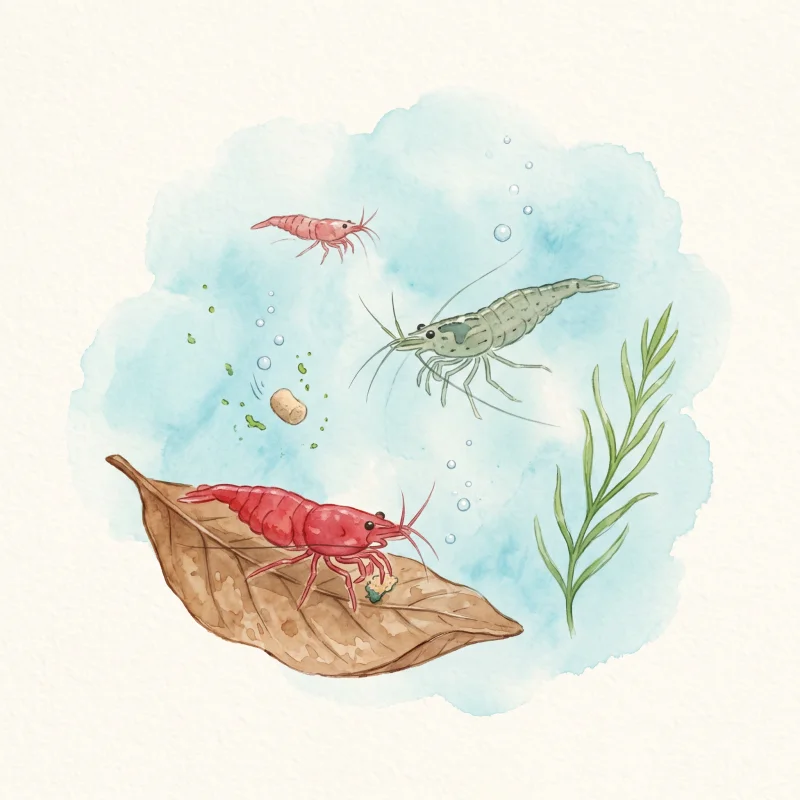
Yes, your shrimp can eat a varied diet!
**Aquarium shrimp are scavengers and biofilm grazers, not true predators.** In a mature, well-cycled tank, biofilm and algae cover most of their nutritional needs. Supplement 2-3 times per week with a high-quality shrimp pellet, blanched vegetables, and occasional protein, plus a constant calcium source for healthy molting. The single biggest cause of shrimp death is **overfeeding**, not underfeeding — when in doubt, feed less.
Shrimp Diet at a Glance
| Food Category | Examples | Frequency |
|---|---|---|
| Biofilm & algae (staple) | Naturally grown in a mature tank | Continuous grazing |
| Shrimp pellets | Hikari Shrimp Cuisine, Shrimp King Complete, GlasGarten Shrimp Dinner | 2× per week |
| Biofilm booster | Bacter AE | 2× per week, tiny pinch |
| Vegetables | Blanched cucumber, zucchini, spinach, romaine | 1–2× per week |
| Leaves | Indian almond, mulberry, stinging nettle (dried) | Always available |
| Protein | Shrimp treat stick, frozen daphnia, fish food crumbs | 1× per week |
| Calcium source | Cuttlebone, mineral stone, crushed coral | Always available |
| Avoid | Copper, bread, salted/seasoned food, fish medications | Never |
| Fasting day | No supplemental food | 1× per week |
What Shrimp Eat (5-Step Routine)
The snippet-ready feeding routine for any aquarium shrimp colony:
- Cycle the tank — Wait 4–6 weeks before adding shrimp. Biofilm is the foundation of their diet.
- Feed Bacter AE or pellet — 2–3 times per week, tiny portion, consumed within 2 hours.
- Add a vegetable — Once or twice a week, blanched cucumber, zucchini, or spinach. Remove after 12–24 hours.
- Keep calcium available — Cuttlebone or mineral stone in the tank at all times.
- Watch and adjust — Shrimp swarm new food when hungry. If they ignore it, you’re overfeeding.
That’s it. Shrimp colonies thrive on consistency, not abundance.
Shrimp Are Detritivores and Biofilm Grazers
In the wild, freshwater shrimp like Neocaridina (cherry shrimp) and Caridina (Crystal Reds, Taiwan Bees) live in densely planted streams and pools. They spend nearly every waking moment grazing — picking microscopic biofilm, algae, and bacteria from rocks, leaves, and decaying matter.
This grazing lifestyle shapes everything about their diet:
- Tiny stomach, constant input — Shrimp eat constantly but in microscopic amounts. Big meals overwhelm them.
- Sensitive to water quality — Uneaten food spikes ammonia, which is lethal to shrimp at much lower concentrations than for fish.
- Need a mature ecosystem — A new sterile tank lacks the biofilm shrimp need. They will starve in a clean tank.
- Molt frequently — Every 3–4 weeks shrimp shed their exoskeleton. They need calcium, magnesium, and trace minerals constantly.
Staple Foods: Biofilm and Pellets
Biofilm (the real staple)
The microscopic film that grows on every surface in a mature tank — bacteria, algae, fungi, infusoria. You cannot see it well, but shrimp can. This is what they eat 90% of the time.
To grow biofilm:
- Keep the tank cycled for 4–6 weeks before adding shrimp
- Add Indian almond leaves, oak leaves, alder cones — all biofilm magnets
- Include driftwood and live plants
- Use a sponge filter (better biofilm surface than canister filters)
Bacter AE — The Biofilm Booster
Bacter AE is a powdered supplement that feeds the biofilm. Add a tiny pinch (literally a pinch — a teaspoon would crash a 20-gallon tank) twice a week. Especially valuable for newly-set-up shrimp tanks and breeding colonies.
Shrimp Pellets and Sticks
A high-quality shrimp pellet is the next layer of nutrition:
| Brand | Type | Best For |
|---|---|---|
| Hikari Shrimp Cuisine | Daily pellet | Cherry shrimp, beginners |
| GlasGarten Shrimp Dinner | Bento-style daily food | Mixed colonies |
| Shrimp King Complete | Premium daily pellet | Caridina, Crystals |
| Mosura Excel / Specialty | Premium Caridina foods | Crystal Reds, Taiwan Bees |
| BorneoWild Color | Color enhancer | Improving red coloration |
Portion: One small pellet per 10 shrimp, 2× per week. Consumed within 2 hours.
Vegetables for Shrimp
Blanched vegetables are excellent supplemental food:
| Vegetable | Prep | Notes |
|---|---|---|
| Cucumber | Blanch 1–2 min | Universally loved, easy |
| Zucchini | Blanch 1–2 min | Very high enthusiasm |
| Spinach | Blanch 30 sec | Calcium boost (also mild laxative) |
| Romaine lettuce | Blanch 15–30 sec | Soft, well-accepted |
| Kale | Blanch 1 min | Nutrient-dense |
| Broccoli florets | Blanch 2 min | Soft tops only |
| Carrot slices | Blanch 2 min | Beta-carotene boost |
Always remove within 12–24 hours. Decomposing vegetables in a shrimp tank are catastrophic for water quality.
Leaves: The Slow-Release Superfood
Botanical leaves are unique to shrimp keeping. They release tannins, slowly grow biofilm, and serve as both food and shelter:
- Indian almond leaves (Catappa) — The classic shrimp leaf. Antibacterial, releases tannins, biofilm magnet
- Mulberry leaves (dried) — High protein, shrimp swarm them
- Stinging nettle (dried) — High calcium, popular with breeding colonies
- Oak leaves — Long-lasting, gentle tannin release
- Alder cones — Strong antifungal, slight pH lowering
Drop a leaf into the tank and leave it. Shrimp will graze on it for 2–4 weeks until it’s gone.
Calcium: Critical for Molting
Every 3–4 weeks, shrimp shed their exoskeleton and grow a new, larger one. Without enough calcium, the molt fails — and a failed molt is fatal.
Calcium sources:
- Cuttlebone (the same kind sold for parrots) — Cheap, effective, just drop a piece in the tank
- Mineral stones (Salty Shrimp Mineral Stone, Shirakura Mineral Stone)
- Crushed coral in the substrate or filter
- Calcium-rich foods — Spinach, kale, Bacter AE
Signs of calcium deficiency:
- White ring around the body (failed molt)
- Soft, partly-shed exoskeleton
- Sudden death after molting
Cherry Shrimp vs Caridina vs Amano: Diet Differences
Cherry Shrimp (Neocaridina davidi)
The easiest. Hardy, eat almost anything, breed prolifically in well-fed tanks.
- Standard shrimp pellets work great
- Tolerate fluctuating parameters
- Cheap food brands fine
Crystal / Caridina Shrimp
The sensitive ones. Soft, slightly acidic water and premium food only.
- Use only premium shrimp foods (Shrimp King, Mosura, BorneoWild)
- Stable parameters more important than food variety
- Avoid copper at all costs
Amano Shrimp (Caridina multidens)
The algae specialists. Larger, less interested in pellets, eats more algae and fish food.
- Will eat shrimp pellets but not enthusiastically
- Excellent algae cleaners — black beard algae, hair algae
- Can hold their own in fish tanks
- Cannot reproduce in freshwater (need brackish for larvae)
Protein: When and How
Shrimp are not strict herbivores — they are scavengers and will eat protein. But too much protein causes:
- Water quality crashes
- Aggressive behavior in colonies
- Failed molts (paradoxically — protein without calcium is incomplete)
Safe protein sources, 1× per week:
- Frozen daphnia (tiny crustaceans, very natural)
- Frozen brine shrimp (rinse first to remove salt)
- A few crumbs of high-quality fish food
- Shrimp treat sticks (designed specifically for shrimp)
Avoid: Bloodworms (too rich), live tubifex (parasite risk), beef heart (way too fatty).
Foods That Will Kill Your Shrimp
The #1 shrimp killer: copper. Even trace amounts are fatal. Sources include:
- Most fish medications (ich treatments, parasite removers, fungal treatments)
- Some commercial fish foods (check ingredient labels)
- Copper sulfate algae treatments
- Old copper pipes leaching into tap water
- Some plant fertilizers (especially Flourish Comprehensive — careful)
Other foods to avoid:
- Bread — expands, no nutrition, fouls water immediately
- Salty or seasoned human food — kills freshwater shrimp via osmotic shock
- Citrus fruit — too acidic, kills biofilm
- Raw potato — solanine is toxic
- Garlic — myth that it’s good; actually harmful in any quantity for shrimp
- Foods with preservatives or artificial colors — unknown toxicity
How Often to Feed: The Critical Rule
Feed less than you think. Most shrimp colonies die from overfeeding, not starvation.
| Tank Type | Feeding Frequency |
|---|---|
| Established tank with mature biofilm | 2× per week |
| New shrimp tank (4–8 weeks old) | 3× per week + Bacter AE |
| Breeding colony | 3× per week, varied diet |
| Quarantine tank | 1× every 2–3 days, tiny portions |
The 2-hour rule: All food should be consumed within 2 hours. If shrimp don’t swarm it, you’re feeding too much or too often.
How Long Can Shrimp Go Without Food?
In a mature, established tank, shrimp can go 1–2 weeks without supplemental food. They graze biofilm and algae continuously. A weekly fasting day actively improves their health.
For vacations:
- 1 week away → no preparation needed in a mature tank
- 2 weeks away → drop in 1–2 Indian almond leaves before leaving
- 3+ weeks away → consider a tank sitter or automatic feeder with a single small pellet every 4 days
Common Mistakes When Feeding Shrimp
Mistake 1: Adding shrimp to a new tank. A bare new tank has no biofilm. Shrimp added to a freshly cycled tank will starve before the biofilm matures. Wait 4–6 weeks minimum.
Mistake 2: Feeding daily. Daily feeding fouls water and triggers planaria/hydra outbreaks. 2–3 times per week is the maximum for healthy adults.
Mistake 3: Using fish food as the staple. Fish food is too high in protein and fillers. Shrimp pellets are formulated for their digestion.
Mistake 4: Ignoring calcium. A diet with zero calcium leads to molting failures within 2–3 cycles. Cuttlebone is the cheapest insurance.
Mistake 5: Treating shrimp tank with copper-based meds. Will wipe out the entire colony. Always check ingredient labels.
Mistake 6: Removing the leaves too soon. Decomposing leaves are food. Leave them in until they’re nearly gone.
What About Mixed Tanks (Fish + Shrimp)?
Most fish will eat shrimp, especially shrimplets (babies). Safe tankmates include:
- Otocinclus catfish (peaceful, share food)
- Small rasboras (chili rasbora, harlequin rasbora)
- Pygmy corydoras
- Snails
In a mixed tank:
- Feed shrimp at lights-out (when fish are less active)
- Use sinking shrimp pellets in densely planted areas
- Provide moss and dense plants for shrimp shelter
- Accept that shrimplet survival will be lower
Frequently Asked Questions
Can shrimp eat dead fish?
Yes — shrimp are scavengers and will clean up dead tankmates. However, a dead fish often signals a problem (disease, water quality) that may also threaten shrimp. Remove the fish, identify the cause, and let shrimp graze on what they find.
Why are my shrimp not eating the food I give them?
Either (a) they’re not hungry because biofilm is abundant, (b) the food is poor quality or stale, or (c) parameters are off and they’re stressed. Try smaller portions and observe — healthy shrimp swarm fresh food within minutes.
Can shrimp eat algae wafers?
Yes. Sinking algae wafers (designed for plecos) work well as occasional shrimp food. Break them into small pieces. Once or twice a week.
Do shrimp need protein for breeding?
Slightly, yes. Add a frozen daphnia or shrimp treat stick once a week to breeding colonies. But don’t overdo it — calcium and stable parameters matter more.
More Foods Your Fish (and Tank Inhabitants) Can Eat
- What Can Bettas Eat? — Complete betta diet guide
- What Can Goldfish Eat? — Complete goldfish diet guide
- Can My Fish Eat Cucumber? — Top vegetable for shrimp and plecos
- Can My Fish Eat Lettuce? — Romaine yes, iceberg no
- Can My Fish Eat Peas? — The swim bladder remedy (and shrimp love them too)
References & Authoritative Sources
The information in this guide is informed by leading veterinary organizations and toxicology resources. For your pet's specific situation, always consult a licensed veterinarian.