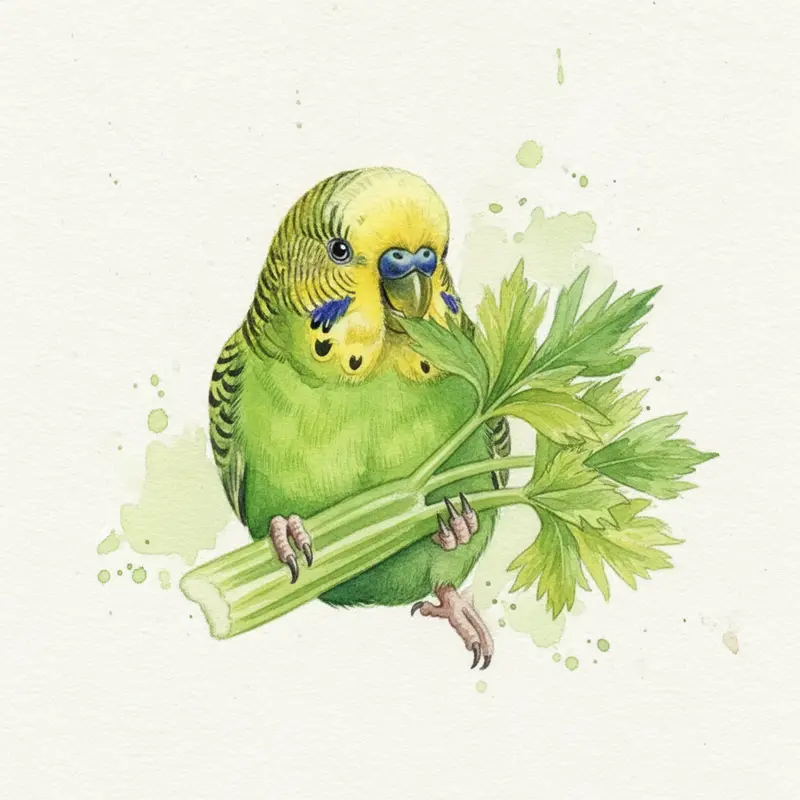
Yes, your bird can eat celery!
Celery is a safe, hydrating, very low-sugar treat for pet birds, and most enjoy shredding it. The one thing worth knowing: the **leaves are the most nutritious part** — richer in vitamin A and calcium than the pale, watery stalk — so offer both rather than just the crunchy stem. Chop the stalk into short pieces so the tough strings end up short, wash it well (celery carries more pesticide residue than most vegetables), and serve it raw and plain. As one vegetable among several in the week, it is all upside.
Is Celery Good for Birds?
Celery is a perfectly good vegetable to hand a pet bird — but it comes with one nuance that most “can my bird eat celery?” articles skip entirely: not all of the celery is equal. The part people throw out is the part birds benefit from most.
The crunchy pale stalk is what we usually think of as celery, and it is fine — it is hydrating, satisfying to shred, and almost sugar-free, which makes it a guilt-free treat. But nutritionally the stalk is mostly water (about 95%) with only modest vitamins and minerals. The leafy green tops, which most people compost, are the nutritional prize: they carry noticeably more vitamin A (as beta-carotene), calcium, and other minerals than the stalk.
That matters for birds specifically:
- Vitamin A — Vitamin A deficiency is the single most common nutritional disease in pet birds kept on seed-heavy diets, affecting skin, feathers, eyes, and the linings of the airway and gut. The beta-carotene in celery leaves is a real plus; the pale stalk offers very little.
- Hydration and low sugar — Celery is around 95% water and barely 1.3g of sugar per 100g, so it is a cooling, guilt-free treat — useful in hot weather and for birds that need to watch their weight.
- Fiber and crunch — The stalk’s fiber supports digestion, and its stringy structure is genuinely fun to shred, which doubles as foraging enrichment.
Key Nutritional Facts: Celery (per 100g, raw)
- Calories: 16 kcal (very low)
- Protein: 0.7g
- Sugar: 1.3g (very low)
- Fiber: 1.6g
- Vitamin A: 449 IU (as beta-carotene; higher in the leaves)
- Vitamin K: 29.3mcg
- Vitamin C: 3.1mg
- Calcium: 40mg
- Sodium: 80mg (relatively high for a vegetable)
- Water: 95%
Leaves vs Stalk, Strings, and Pesticides: What Actually Matters
Celery is not toxic and has no scary hidden danger, so the useful advice is about getting the most out of it and sidestepping three small, real issues.
1. Favor the leaves. As above, the leafy tops out-nutrition the stalk. Don’t trim and bin them — chop them in, or offer a leafy sprig on its own. For a seed-fed bird that needs vitamin A, the leaves are the better half of the vegetable.
2. Chop the strings short. Celery’s long, tough fibers (“strings”) run the length of the stalk. For most parrots and small birds this is a non-issue — they shred the stalk and drop the strands rather than swallowing them. The one group where it is worth real care is backyard chickens and other poultry, which tend to gulp food: long tough strings can ball up and contribute to a crop impaction. The fix is universal and simple — slice the stalk crosswise into short pieces, which cuts every string into a harmless short length while keeping all the crunch.
3. Wash it well — celery is a “Dirty Dozen” crop. Celery consistently ranks among the vegetables highest in pesticide residue. That matters more for birds than for us for one reason: a budgie weighs 30-40g, so the dose of residue per gram of body weight from a nibble is far higher than it is for a person eating the same piece. Wash celery thoroughly under running water, choose organic where you can, and there is no problem — but don’t skip the wash.
A fourth, minor point: celery has a relatively high natural sodium content for a vegetable (about 80mg/100g). In the small amounts birds eat this is harmless, but it is one more reason never to add salt, and to keep celery as one vegetable among several rather than a daily bulk food.
Portion Sizes by Bird Species
Celery is low-sugar and low-calorie, so it can appear regularly — but because it is mostly water with modest nutrition, treat it as one vegetable in a varied rotation, not a staple. Aim for vegetables at roughly 15-20% of the diet, fruit at 10-15%, and pellets as the 60-70% base.
Small birds (budgies, parakeets, finches, canaries, lovebirds):
- A short piece of chopped stalk (about 1-2cm) with a few leaves attached
- 1-2 times per week
- The leafy tops are the most valuable part for these seed-prone species
Medium birds (cockatiels, conures, quaker parrots, caiques):
- A short length of sliced stalk plus leaves
- 2-3 times per week
- A ribbed stalk piece is satisfying to shred and strip
Large birds (African greys, amazons, macaws, cockatoos, eclectus):
- A full stalk length to shred and work apart, leaves included
- 2-3 times per week
- Great as a low-calorie foraging item for birds watching their weight
Can Specific Birds Eat Celery?
The portions above give the numbers, but the most common question is whether celery is safe for a particular kind of bird. The answer is yes across the board — the differences are portion size and how you prepare it.
Can Parrots Eat Celery?
Yes. Large parrots (African greys, amazons, macaws, cockatoos) can enjoy a full stalk length to shred two to three times a week, leaves included. Parrots get the most fun out of celery because the fibrous stalk is made to be stripped apart stem by stem — natural, absorbing foraging. Because celery is so low in calories, it is a useful treat for overweight parrots or species like amazons that are prone to weight gain. Serve it raw, plain, and well washed.
Can Budgies Eat Celery?
Yes. Budgies (parakeets) are tiny (30-40g), so a short piece of chopped stalk with the leaves attached, once or twice a week, is plenty. Chop the stalk crosswise so the strings are short, and lean on the leafy tops — they give your budgie the vitamin A that an all-seed diet lacks. Celery’s very low sugar makes it a sensible treat, but it is mostly water, so it should sit alongside nutrient-dense greens, not replace them.
Can Cockatiels Eat Celery?
Yes. Cockatiels can have a short length of sliced stalk plus leaves, two to three times a week. Cockatiels can be wary of new textures, so try clipping a leafy celery top where they can investigate it, or chopping the stalk small and mixing it into a familiar veg “chop.” Give it a week or two of low-pressure exposure before deciding your cockatiel dislikes it — many warm up once the food feels familiar.
Can Conures and Lovebirds Eat Celery?
Yes. These busy, playful parrots usually take to celery readily and enjoy the shredding. Conures can have a short stalk length, and lovebirds a small chopped piece with leaves, two to three times a week. Their shredding instinct makes a strip of stalk a perfect foraging treat — weave it through the cage bars and let them pull it apart.
Can Chickens and Backyard Birds Eat Celery?
Yes, chickens can eat celery, but this is the one group where the strings matter. Chickens gulp food rather than shredding it, so long tough celery strings can occasionally contribute to a crop impaction. Always chop celery into short crosswise pieces for poultry (never offer a whole long stalk), and the leaves and chopped stalk make a healthy, hydrating scrap-bowl addition.
Raw or Cooked? Stalk, Leaves, and Preparation
This is where the practical do’s and don’ts live. The celery itself is safe; how you prepare and which part you serve makes the difference.
Raw vs cooked:
- Raw celery — The best choice for birds. It keeps the water content and crunch intact, which is exactly what makes it a good hydrating, foraging treat. A raw stalk is the classic presentation.
- Cooked celery — Not harmful, but there is little point. Cooking makes it limp, leaches out water-soluble vitamins, and removes the crunch that makes it fun. If you do offer cooked celery (for example mixed into a warm “chop”), keep it plain and let it cool to room temperature.
Which parts:
- Leaves — The nutritional prize: more vitamin A and calcium than the stalk. Offer them fresh.
- Stalk — Hydrating and fun to shred; slice crosswise into short pieces to shorten the strings.
- Base/root end — Trim off and discard the tough white base, which can trap grit; wash the rest well.
Rotating celery with other vegetables adds variety. Wash everything well (organic where possible), since celery is one of the higher-residue vegetables.
Celery Forms and Products to Avoid
Only plain fresh celery is appropriate. Skip these:
- Celery with peanut butter, cheese, or dips — The “ants on a log” treat is for humans; salt, fat, and dairy are all wrong for birds, which are lactose-intolerant.
- Salted, buttered, or seasoned celery — Excess sodium is genuinely risky for small birds, and celery already carries natural sodium. Plain only.
- Celery cooked with garlic or onion — Both are toxic to birds. Avoid any dish seasoned this way, including stuffing, soup, and stir-fry.
- Celery salt or celery seed seasoning — These are concentrated and salty; not the same as fresh celery, and not for birds.
- Old, slimy, or moldy celery — Toss it; mold is dangerous to birds.
Whichever form you choose, serve celery plain and washed, and remove uneaten fresh pieces within a few hours, since they wilt and can grow bacteria, sooner in warm weather.
How to Serve Celery to Your Bird
Leafy top on a clip — Clip a washed leafy celery top to the cage bars; the most nutritious part and a natural foraging nibble.
Short chopped stalk — Slice the stalk crosswise into short pieces (shortening the strings) and offer on their own or in a mixed veg “chop” for small birds.
Stalk strip to shred — Give medium and large parrots a length of stalk to strip apart stem by stem — absorbing foraging.
Veg “chop” mix — Finely chop celery and leaves into a mixed vegetable serving to introduce it to a wary eater.
Always wash celery well and rotate it with other greens so no single vegetable dominates the week.
Signs Your Bird Has Eaten Too Much Celery
Celery is not toxic, but overdoing a watery vegetable can cause mild issues:
- Watery droppings (polyuria) after a large fresh-food serving — celery is 95% water, so more liquid in the droppings is expected and self-limiting. It is easy to mistake for diarrhea; the fix is simply smaller portions.
- Filling up on celery and ignoring pellets and nutrient-dense greens — a variety problem, not a safety one, and a real one because celery is so low in calories and nutrition.
- Dropped strings around the cage — harmless for most birds, but a reminder to chop the stalk short, especially for poultry.
These are minor and resolve once you return to modest portions. If watery droppings persist for more than a day, if your bird seems genuinely unwell, or if a chicken shows a swollen or firm crop, consult an avian veterinarian.
ZuPreem FruitBlend Bird Food for Medium Birds
A nutritionally complete pelleted diet that should form the foundation of your bird's meals, fortified with the vitamin A and balanced minerals that seed diets lack. Hydrating, low-calorie vegetables like celery make a good natural supplement, but treats sit on top of solid daily nutrition, not in place of it. Designed for cockatiels, conures, lovebirds, and similar medium-sized species.
$18.99 View on AmazonAs an Amazon Associate, we earn from qualifying purchases.
Frequently Asked Questions
Can baby birds eat celery?
Hand-fed baby birds should stay on their formula until they are fully weaned and eating solid food on their own. Once weaned, a little finely chopped celery (leaves included) can be one of the vegetables you introduce, watching for any digestive upset. Start small.
Is celery juice or celery leaves better for birds?
Skip the juice — it concentrates the sodium and strips the fiber, and birds get their water from fresh food and the water bowl. The leaves are the part to favor: they carry more vitamin A, calcium, and minerals than the stalk, which is mostly water.
Why is my bird’s poop watery after eating celery?
Because celery is about 95% water. Eating a watery vegetable naturally makes droppings looser for a few hours — this is polyuria, not true diarrhea, and it settles on its own. Offer a smaller piece next time. If the watery droppings last more than a day or your bird seems unwell, see an avian vet.
Can birds eat celery every day?
It is fine as a frequent treat because it is so low in sugar and calories, but it should not be the only or main vegetable, since it is mostly water with modest nutrition. Rotate it with more nutrient-dense greens, carrot, and other vegetables so the diet stays varied and complete.
More Foods Your Bird Can and Cannot Eat
Wondering what else is safe for your bird? Check out our other bird food safety guides:
- Can My Bird Eat Broccoli? — A calcium-rich veggie, best in moderation
- Can My Bird Eat Carrots? — A vitamin A powerhouse
- Can My Bird Eat Cucumber? — A safe, low-sugar, hydrating treat
- Can My Bird Eat Lettuce? — Romaine yes, iceberg no
- Can My Bird Eat Peas? — A high-protein veggie they can forage
- Can My Bird Eat Apples? — Safe flesh, but the seeds are toxic
- Can My Bird Eat Strawberries? — A safe, vitamin-rich fruit they love
- Can My Bird Eat Grapes? — Safe unlike dogs, but watch the pesticides
- Can My Bird Eat Bananas? — A tropical treat they will go crazy for
- Can My Bird Eat Rice? — Cooked and plain, a safe everyday grain
- Can My Bird Eat Avocado? — A deadly fruit for your feathered friend
- Can My Bird Eat Chocolate? — Absolutely not, here is why
References & Authoritative Sources
The information in this guide is informed by leading veterinary organizations and toxicology resources. For your pet's specific situation, always consult a licensed veterinarian.