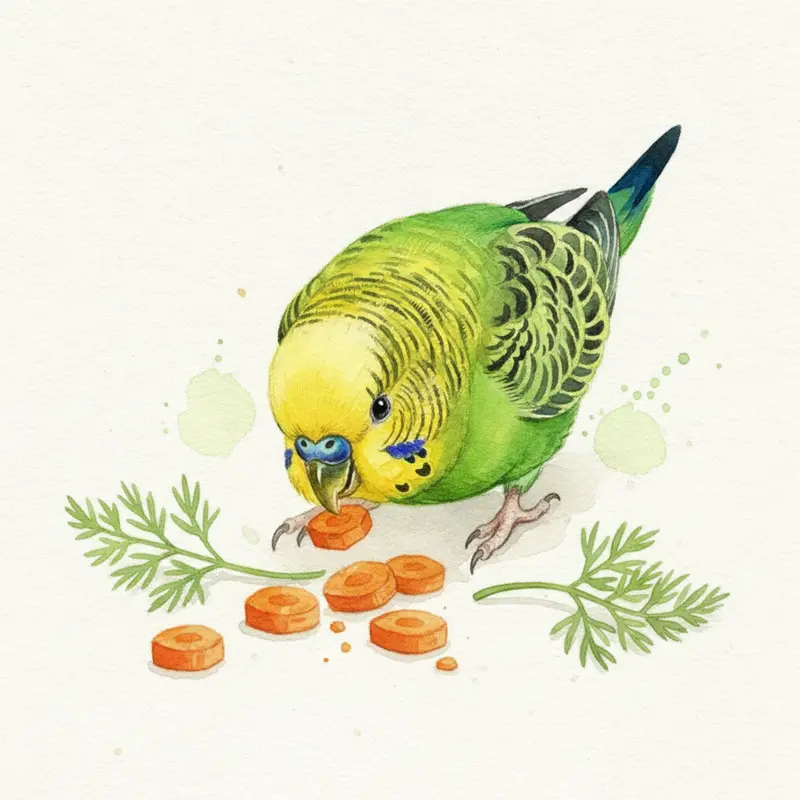
Yes, your bird can eat carrots!
Carrots are a safe, nutritious treat for most pet birds — and one of the more genuinely beneficial vegetables you can offer. They are non-toxic and packed with beta-carotene, which birds convert into vitamin A. That matters because vitamin A deficiency is the most common nutritional problem in pet birds, especially those on seed-heavy diets. Both the root and the leafy tops are safe. Serve them raw (grated or in sticks) or lightly steamed, always plain, a few times a week as part of a varied diet.
Why Carrots Are a Great Treat for Birds
Most “can my bird eat this?” questions end with a list of cautions. Carrots are refreshingly different: they are not just safe, they are actively good for birds. The reason comes down to one nutrient that pet birds are famously short of — vitamin A.
Carrots get their orange color from beta-carotene, a pigment the body converts into vitamin A. Birds are efficient at this conversion, which makes carrots one of the best natural sources of vitamin A you can put in a food bowl. And unlike the serious safety catches that come with some foods (avocado is toxic to birds, chocolate is dangerous, apple seeds contain cyanide), carrots have no hidden hazard — just wash them and serve them plain.
The benefits of carrots for birds include:
- Beta-carotene / vitamin A — This is the headline. Vitamin A supports healthy skin, feathers, eyes, and the linings of the respiratory and digestive tracts. Carrots are one of the richest, safest sources.
- Fiber — Supports healthy digestion and gives foraging birds something satisfying to chew.
- Antioxidants — Beta-carotene and other carotenoids act as antioxidants that support overall health.
- Enrichment — A chunk of raw carrot or a bundle of feathery carrot tops gives birds something to shred, grip, and gnaw, which helps break up dietary boredom.
- Moderate sugar, no fat — Carrots are sweeter than cucumber but far less sugary than fruit, and virtually fat-free, so they suit most birds in sensible amounts.
Key Nutritional Facts: Carrot (per 100g, raw)
- Calories: 41 kcal
- Sugar: 4.7g (moderate)
- Fiber: 2.8g
- Vitamin A (as beta-carotene): 16,706 IU
- Beta-carotene: 8,285mcg
- Vitamin K: 13.2mcg
- Potassium: 320mg
- Water: 88%
- Fat: 0.2g (very low)
The Vitamin A Story: Why Carrots Matter So Much for Birds
If there is one nutrient worth understanding for bird owners, it is vitamin A. Hypovitaminosis A (vitamin A deficiency) is the most common nutritional disease avian veterinarians see, and it is largely a product of the classic all-seed diet. Seeds — especially sunflower and millet — are low in vitamin A, so a bird living mostly on seed slowly runs short.
The consequences are serious and often creep up quietly:
- Respiratory problems — Vitamin A keeps the linings of the airways healthy. A deficient bird is more prone to sinus infections, nasal discharge, and wheezing.
- Poor feather and skin quality — Dull, ragged, or poorly colored feathers can be a sign.
- Mouth and eye changes — White plaques in the mouth, swollen eyes, and blocked tear ducts are classic advanced signs.
- Weakened immunity — Deficient birds fight off infections less well.
This is exactly why carrots are such a useful food. Offering carrot — alongside other vitamin-A-rich vegetables like sweet potato, dark leafy greens, and red bell pepper — is one of the simplest ways to shore up a bird’s vitamin A intake. The best long-term fix is a pelleted diet (pellets are fortified with vitamin A), but fresh vegetables like carrot are a valuable, natural supplement on top.
A quick word of balance: it is possible to over-supplement vitamin A with synthetic supplements, but you cannot realistically cause a problem by feeding fresh carrots. The body converts only as much beta-carotene as it needs, so carrot is a safe way to support vitamin A without the risk that comes from vitamin drops.
Portion Sizes by Bird Species
Because carrots are a vegetable rather than a sugary fruit, they can appear a little more regularly in the diet — but they are still a treat alongside a balanced foundation. Aim for vegetables at roughly 15-20% of the diet, fruit at 10-15%, and pellets as the 60-70% base.
Small birds (budgies, parakeets, finches, canaries, lovebirds):
- About a teaspoon of grated carrot, or a thin matchstick
- 2-3 times per week
- Grating makes it easy for tiny beaks; many also enjoy shredding the leafy tops
Medium birds (cockatiels, conures, quaker parrots, caiques):
- A tablespoon of grated or diced carrot, or a small chunk to gnaw
- 2-3 times per week
- A chunk clipped to the cage bars doubles as foraging enrichment
Large birds (African greys, amazons, macaws, cockatoos, eclectus):
- A few matchsticks or a small chunk
- 2-3 times per week
- Big parrots enjoy the workout of gripping and gnawing a whole baby carrot or thick stick
Can Specific Birds Eat Carrots?
The portions above give the numbers, but the most common question is whether carrots are safe for a particular kind of bird. The answer is yes across the board — the difference is portion size and how you cut it.
Can Parrots Eat Carrots?
Yes. Large parrots (African greys, amazons, macaws, cockatoos) can enjoy a few matchsticks or a small chunk two to three times a week, raw or lightly steamed. Carrots are especially worthwhile for parrots because so many are kept on seed-rich diets that leave them short of vitamin A — African greys in particular are prone to vitamin A and calcium issues. A raw carrot stick also gives a strong-beaked parrot a satisfying thing to grip, shred, and gnaw, which is good enrichment.
Can Budgies Eat Carrots?
Yes, and they are a smart choice for budgies specifically. Budgies (parakeets) are one of the species most affected by all-seed diets and vitamin A deficiency, so a little carrot is genuinely beneficial. Because they are tiny (30-40g), offer about a teaspoon of grated carrot or a thin matchstick two to three times a week. Grated carrot is easiest for their small beaks, and many budgies also love picking apart the feathery green tops.
Can Cockatiels Eat Carrots?
Yes. Cockatiels can have a tablespoon of grated or diced carrot, or a small chunk, two to three times a week. Cockatiels can be suspicious of new foods, so try mixing a little grated carrot into a familiar vegetable, or clip a piece to the bars where they can investigate it at their own pace. Give it a week or two of repeated exposure before deciding your bird dislikes it — many cockatiels warm up to carrot once it feels familiar.
Can Conures and Lovebirds Eat Carrots?
Yes. These lively parrots usually take to carrot readily. Conures can have a small chunk or a few matchsticks, and lovebirds a teaspoon of grated carrot or a thin stick, two to three times a week. Their playful, chewy nature makes a carrot stick or a bundle of carrot tops a good enrichment treat clipped to the cage bars.
Should You Feed Carrots Raw or Cooked?
Both work, and each has a small advantage:
- Raw carrot — Keeps the most nutrients and gives birds something to chew, which is good for the beak and for enrichment. Grate it for small birds, cut matchsticks or chunks for larger ones. Raw is the best everyday choice for most birds.
- Lightly steamed carrot — Softer and easier to eat, which can suit very small birds, babies just weaned, or older birds. Steam only until slightly tender; do not boil to mush, as that leaches out nutrients. Let it cool fully before serving.
Whichever you choose, serve it plain. No butter, oil, salt, sugar, honey glaze, or seasoning — these range from unnecessary to genuinely harmful for birds.
Are Carrot Tops Safe for Birds?
Yes — and they are a lovely bonus. The leafy green carrot tops are safe, nutritious, and often even better than the root: they are lower in sugar, higher in fiber, and rich in vitamins. Wash them thoroughly to remove pesticides, then offer them fresh as part of the leafy-green share of the diet. Many birds enjoy the enrichment of shredding the feathery greens, and you can hang a bundle in the cage for foraging. If you buy carrots with the tops attached, do not throw them away.
How to Serve Carrots to Your Bird
Grated — The easiest form for small birds like budgies and finches; sprinkle over their usual chop or veg mix.
Matchsticks or thin sticks — Good for medium and large birds that like to hold food in a foot and chew.
A chunk or baby carrot to gnaw — Big parrots enjoy the workout of gripping and shredding a whole piece; clip it to the cage bars for foraging.
Lightly steamed and cooled — A soft option for babies, seniors, or fussy eaters; serve plain and fully cooled.
Carrot tops on a clip — Hang a washed bundle of the leafy greens for the bird to shred.
Always wash carrots well (organic where possible) to remove pesticide residue, and remove uneaten fresh carrot within a few hours, since it spoils and can grow bacteria — sooner in warm weather.
Carrot Products to Avoid
Only fresh, plain carrot (raw or lightly steamed) is appropriate. Skip these:
- Canned carrots — Usually high in added salt; excess sodium is dangerous for small birds.
- Glazed, candied, or honey carrots — Loaded with sugar; a holiday side dish is not a bird food.
- Carrot cake, muffins, or juice with additives — Contain sugar, fat, and other ingredients birds do not need.
- Seasoned or buttered carrots — Garlic, onion, salt, and butter are all inappropriate or toxic for birds.
Signs Your Bird Has Eaten Too Much Carrot
Carrots are not toxic, but as with any treat, overdoing it can crowd out the balanced diet or cause mild upset:
- Loose droppings after a large fresh-food serving
- Filling up on carrot and ignoring pellets and other vegetables
- Temporary orange tint to droppings from the pigment (harmless, but a cue to cut back)
These are minor and resolve once you return to modest portions. Carrots should complement a pelleted or well-balanced diet, not replace it. If droppings stay abnormal for more than a day, consult an avian veterinarian.
ZuPreem FruitBlend Bird Food for Medium Birds
A nutritionally complete pelleted diet that should form the foundation of your bird's meals — and, importantly, one that is fortified with vitamin A. Fresh vegetables like carrot make an excellent natural supplement, but treats sit on top of solid daily nutrition, not in place of it. Designed for cockatiels, conures, lovebirds, and similar medium-sized species.
$18.99 View on AmazonAs an Amazon Associate, we earn from qualifying purchases.
Frequently Asked Questions
Can baby birds eat carrots?
Hand-fed baby birds should stay on their formula until they are fully weaned and eating solid food on their own. Once weaned, a little finely grated raw carrot or a small piece of soft steamed carrot can be one of the first vegetables you introduce, watching for any digestive upset. Start small.
Do carrots really help with vitamin A deficiency in birds?
Yes. Carrots are one of the best natural sources of beta-carotene, which birds convert into vitamin A. For birds on seed-heavy diets — the most common cause of vitamin A deficiency — adding carrot and other vitamin-A-rich vegetables (sweet potato, dark leafy greens, red bell pepper) is a simple, effective way to help. For birds already showing signs of deficiency, see an avian vet; the long-term fix is usually switching to a fortified pelleted diet.
Can birds eat carrot greens (tops)?
Yes. Carrot tops are safe, low in sugar, and nutritious — often better than the root. Wash them well and offer them fresh as part of the leafy-green portion of the diet. Many birds enjoy shredding the feathery greens as enrichment.
My bird’s droppings turned slightly orange after eating carrot — is that a problem?
No. A temporary orange tint comes from the beta-carotene pigment and is harmless. It simply means your bird ate a fair amount of carrot; scale the portion back a little and it will pass.
More Foods Your Bird Can and Cannot Eat
Wondering what else is safe for your bird? Check out our other bird food safety guides:
- Can My Bird Eat Apples? — Safe flesh, but the seeds are toxic
- Can My Bird Eat Cucumber? — A safe, low-sugar, hydrating treat
- Can My Bird Eat Strawberries? — A safe, vitamin-rich fruit they love
- Can My Bird Eat Bananas? — A tropical treat they will go crazy for
- Can My Bird Eat Grapes? — Safe unlike dogs, but watch the pesticides
- Can My Bird Eat Avocado? — A deadly fruit for your feathered friend
- Can My Bird Eat Chocolate? — Absolutely not, here is why
- Can My Bird Eat Rice? — Cooked and plain, a safe everyday grain
- Can My Bird Eat Lettuce? — Romaine yes, iceberg no
- Can My Bird Eat Peas? — A high-protein veggie they can forage
- Can My Bird Eat Broccoli? — A calcium-rich veggie, best in moderation
- Can My Bird Eat Celery? — A hydrating, low-sugar treat, leaves first
References & Authoritative Sources
The information in this guide is informed by leading veterinary organizations and toxicology resources. For your pet's specific situation, always consult a licensed veterinarian.