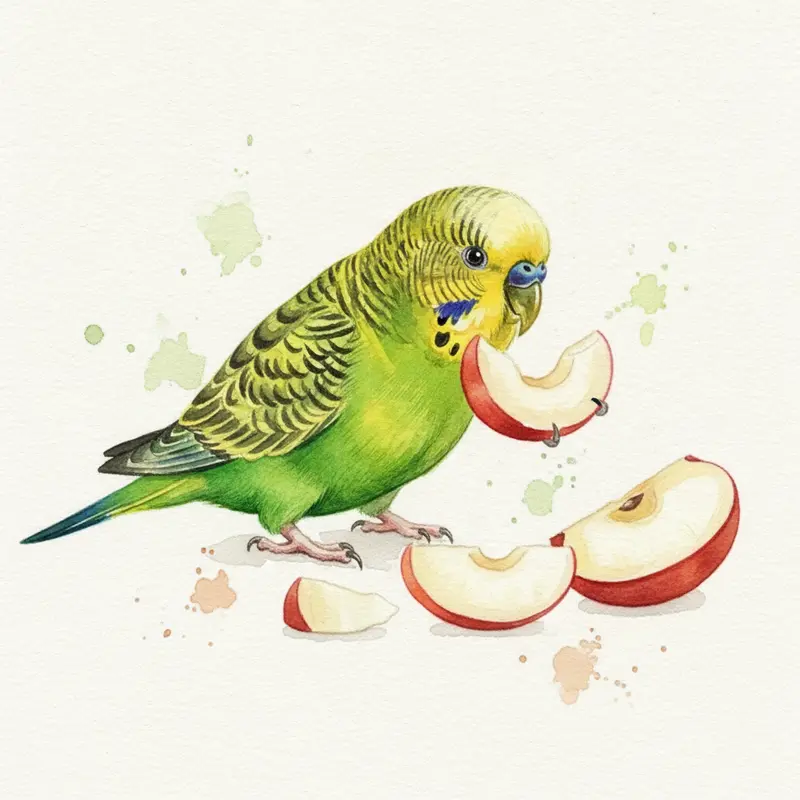
Caution: apples requires care for your bird.
Apple flesh is a safe and genuinely healthy treat for birds — it offers fiber, vitamin C, and hydration, and most birds love it. The caution rating is about two things: the **seeds**, which contain cyanide-releasing amygdalin and must always be removed, and **pesticide residue**, since apples are among the most heavily sprayed fruits and birds are exceptionally sensitive to chemicals. Serve washed, seed-free flesh in small portions and apple is a great addition to the treat rotation.
Why Apple Is a Good Treat for Birds
Apple flesh is one of the more nutritious fruit treats you can offer a bird. In appropriate amounts it provides:
- Vitamin C — Supports immune function and general health
- Dietary fiber — Aids digestion, especially the pectin in apple flesh
- Hydration — Apples are about 86% water, a nice boost on warm days
- Antioxidants — Including quercetin, which helps protect cells from damage
- Foraging enrichment — A wedge of apple gives a bird something to hold, tear, and work at, which is mentally stimulating
Key Nutritional Facts: Apple (per 100g, raw, with skin)
- Calories: 52 kcal
- Sugar: 10.4g
- Fiber: 2.4g
- Vitamin C: 4.6mg
- Potassium: 107mg
- Vitamin K: 2.2mcg
- Water: 86%
The Seed Danger: Why You Must Core the Apple
The single most important rule with apples and birds is simple: never let your bird eat the seeds.
Apple seeds contain amygdalin, a compound that releases hydrogen cyanide when the seed is crushed or chewed. A whole, swallowed seed usually passes through intact, but birds have powerful beaks — a parrot or even a determined budgie will crack a seed open, releasing the toxin.
Why this matters more for birds than for people:
A budgie weighs around 30–40 grams, and a cockatiel around 90 grams. Because the toxic dose scales with body weight, a quantity of cyanide that is harmless to an adult human can seriously harm a small bird. There is no benefit to the seeds and a real risk, so the safe approach is absolute: core every apple and remove all seeds before serving.
Signs of cyanide toxicity in birds:
- Rapid or labored breathing
- Weakness, fluffed-up posture, or sitting on the cage floor
- Loss of coordination
- Seizures
If you suspect your bird has chewed apple seeds and shows any of these signs, contact an avian veterinarian immediately.
Portion Sizes by Bird Species
Apple’s sugar means it stays a treat, not a staple. Fruit as a whole should be no more than 10–15% of the diet, with pellets and vegetables forming the base.
| Bird Type | Apple Portion | Frequency |
|---|---|---|
| Finches & canaries | A sliver, thumbnail-sized | 2-3 times per week |
| Budgies (parakeets) | 1-2 thumbnail-sized pieces | 2-3 times per week |
| Cockatiels | 2-3 small pieces | 2-3 times per week |
| Conures & lovebirds | A few small pieces | 2-3 times per week |
| Large parrots (greys, amazons, macaws) | 1-2 thin slices (seed-free) | 2-3 times per week |
Can Specific Birds Eat Apples?
The portions above scale with size, but owners usually want to know about their particular species.
Can Parrots Eat Apples?
Yes. Large parrots — African greys, amazons, macaws, and cockatoos — enjoy apple and can handle a thin slice or two. Their strong beaks are exactly why the seed rule matters most for them: a parrot will crack seeds effortlessly, so core the apple completely. Offering apple on a foraging skewer turns the treat into enrichment.
Can Budgies Eat Apples?
Yes. Budgies (parakeets) love apple, but their small size means small portions — one or two thumbnail-sized pieces, two to three times a week. Remove all seeds and offer the flesh in a shallow dish or clipped to the cage bars.
Can Cockatiels Eat Apples?
Yes. Cockatiels handle apple well at two or three small pieces a couple of times a week. As with all birds, wash the fruit well and remove the core and seeds. Many cockatiels prefer apple slightly warmed to room temperature over cold-from-the-fridge pieces.
Can Conures and Lovebirds Eat Apples?
Yes. These lively small parrots enjoy apple as part of a varied fresh-food rotation. Give a few small seed-free pieces two to three times a week, and pair fruit days with vegetables like leafy greens and bell pepper to keep the overall sugar low.
Pesticides: Wash Well or Buy Organic
Apples consistently rank near the top of the Environmental Working Group’s “Dirty Dozen” list of produce with the highest pesticide residue. Birds have an extraordinarily efficient respiratory system and a tiny body mass, which makes them far more sensitive to chemical residues than mammals.
- Buy organic apples when you can, especially if apple is a regular treat
- For conventional apples, wash thoroughly under running water, ideally with a brief vinegar soak, and consider peeling
- Never offer apple with waxy, unwashed skin straight from the store
Which Parts of the Apple Are Safe?
| Part | Safe? | Notes |
|---|---|---|
| Flesh (white part) | Yes | The main edible portion; cut into bird-sized pieces |
| Skin/peel | Yes, washed | Safe and nutritious if organic or well washed |
| Seeds | No — toxic | Contain amygdalin (cyanide); remove every one |
| Core | No | Tough and holds the seeds |
| Stem & leaves | No | Choking risk and possible pesticide residue |
How to Serve Apple to Your Bird
- Wash thoroughly — Even organic apples should be rinsed well
- Cut in half and core — Remove the entire core and every seed
- Peel if not organic — Conventional skin may hold pesticide residue
- Cut to size — Small pieces for small birds, thin slices for parrots
- Offer in a dish or on a skewer — A foraging skewer adds enrichment
- Remove uneaten apple within a few hours — Fresh fruit spoils quickly and can grow mold
Apple Products to Avoid
- Apple juice — Concentrated sugar with none of the fiber; not appropriate
- Applesauce — Usually contains added sugar and offers no benefit over fresh
- Apple pie, chips, or baked apple — Added sugar, fat, and sometimes spices
- Anything with the core intact — Never take the shortcut of handing over a whole slice with seeds
Signs Your Bird Has Had Too Much Apple
Apple is gentle, but too much fruit sugar can cause problems:
- Loose or watery droppings — The most common sign of too much fruit
- Reduced appetite for pellets — A bird filling up on sweet treats may skip its staple food
- Weight changes — Excess fruit sugar contributes to obesity over time
If you notice loose droppings, cut back on fruit and make sure pellets and vegetables dominate the diet. Persistent changes warrant a call to an avian veterinarian.
Frequently Asked Questions
Can baby birds eat apple?
Hand-fed chicks should be raised on an appropriate formula, not fruit. Once a young bird is fully weaned and eating solid foods confidently, you can introduce tiny amounts of seed-free apple flesh as part of a varied diet.
My bird ate an apple seed. What should I do?
A single swallowed seed that was not crushed is unlikely to cause harm, but monitor your bird closely for 12–24 hours for labored breathing, weakness, or loss of coordination. If any symptoms appear, contact an avian veterinarian right away. Going forward, always core the apple completely.
Is cooked apple safe for birds?
Plain, unsweetened cooked apple (with no sugar, butter, or spices) is safe but offers less than fresh — cooking reduces the vitamin C. Fresh, raw, seed-free apple is the better choice.
More Foods Your Bird Can and Cannot Eat
Wondering what else is safe for your bird? Check out our other bird food safety guides:
- Can My Bird Eat Strawberries? — A safe, vitamin-rich fruit they love
- Can My Bird Eat Grapes? — Safe unlike dogs, but watch the pesticides
- Can My Bird Eat Bananas? — A tropical treat they will go crazy for
- Can My Bird Eat Cucumber? — A safe, low-sugar, hydrating treat
- Can My Bird Eat Carrots? — Rich in vitamin A for feather health
- Can My Bird Eat Broccoli? — A calcium-rich veggie, best in moderation
- Can My Bird Eat Celery? — A hydrating, low-sugar treat, leaves first
- Can My Bird Eat Lettuce? — Romaine yes, iceberg no
- Can My Bird Eat Rice? — Cooked and plain, a safe everyday grain
- Can My Bird Eat Avocado? — A deadly fruit for your feathered friend
- Can My Bird Eat Chocolate? — Absolutely not, here is why
- Can My Bird Eat Peas? — A high-protein veggie they can forage
References & Authoritative Sources
The information in this guide is informed by leading veterinary organizations and toxicology resources. For your pet's specific situation, always consult a licensed veterinarian.