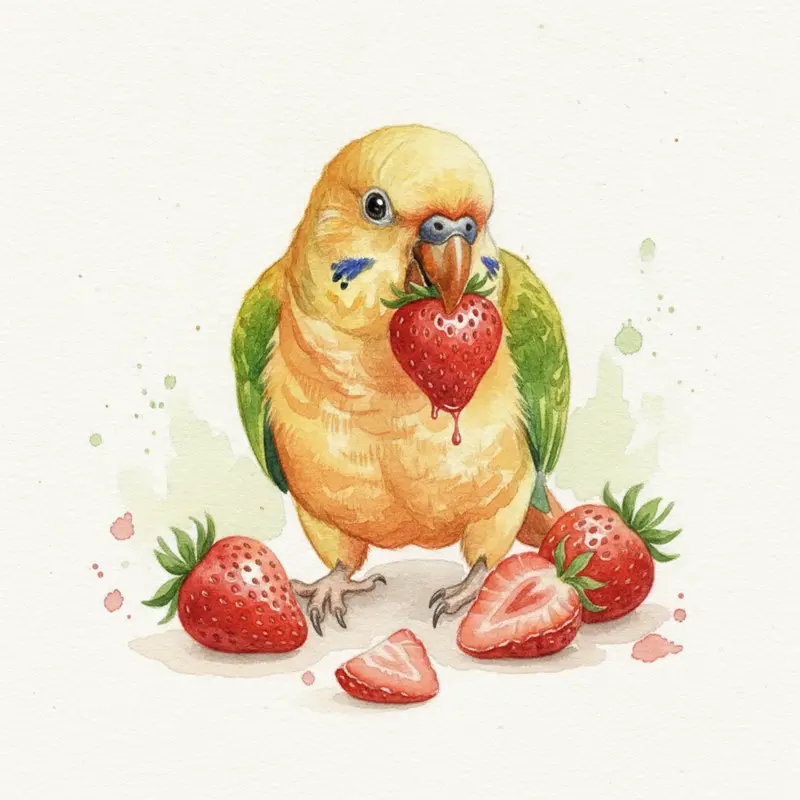
Yes, your bird can eat strawberries!
Strawberries are a safe, nutritious treat for most pet birds. They deliver vitamin C, antioxidants, fiber, and hydration, and the tiny seeds and leafy tops are harmless — unlike the seeds of apples or the pits of stone fruit. Keep portions modest (fruit should be no more than 10-15% of the diet) and wash thoroughly or buy organic, because strawberries carry some of the highest pesticide residues of any fruit.
Why Strawberries Are Good for Birds
Strawberries are one of the friendliest fruits you can offer a pet bird. They are soft, easy to hold in a foot or beak, brightly colored (birds are drawn to red and orange), and packed with nutrients birds actually benefit from. Most birds — from budgies to macaws — take to strawberries quickly, which makes them a great treat for foraging enrichment and hand-taming.
Unlike some fruits that come with a safety catch (avocado is toxic, apple seeds contain cyanide, grapes carry a heavy pesticide load), strawberries are straightforwardly safe. The only two things to manage are sugar and pesticides, both of which are easy to handle with proper portions and washing.
Key Nutritional Facts: Strawberries (per 100g)
- Calories: 32 kcal
- Sugar: 4.9g (lower than banana, apple, or grape)
- Vitamin C: 58.8mg
- Fiber: 2.0g
- Manganese: 0.39mg
- Folate: 24mcg
- Water: 91%
- Fat: 0.3g (very low)
Key nutritional benefits for birds
- Vitamin C — Strawberries are exceptionally rich in vitamin C. While many birds can synthesize some of their own, supplemental vitamin C supports immune function, feather health, and recovery from stress or illness.
- Antioxidants — The anthocyanins that make strawberries red, along with ellagic acid and quercetin, help fight cellular damage from free radicals.
- Hydration — At 91% water, strawberries are a gentle way to add moisture, useful in hot weather or for birds that do not drink much.
- Low sugar for a fruit — At 4.9g per 100g, strawberries have noticeably less sugar than bananas, grapes, or mango, making them one of the smarter fruit choices for weight-prone birds.
- Fiber — Supports healthy digestion and gut motility.
The Two Real Concerns: Pesticides and Sugar
Pesticide residue
Strawberries consistently top the Environmental Working Group’s “Dirty Dozen” list of the most pesticide-contaminated produce. Birds are far more sensitive to chemicals than mammals because of their small body size, fast metabolism, and highly efficient respiratory system, which absorbs airborne and ingested toxins rapidly.
To minimize exposure:
- Buy organic whenever possible — the single most effective step
- Vinegar soak — three parts water to one part white vinegar for 10-15 minutes, then rinse well
- Baking soda soak — one teaspoon per two cups of water for about 15 minutes removes more residue than plain water
- Scrub gently under cool running water, paying attention to the seedy surface and the leafy top where residue collects
Sugar
Even though strawberries are lower in sugar than most fruits, birds are small and a fruit-heavy diet can cause problems: obesity (amazons and budgies are especially prone to fatty liver disease), yeast overgrowth in the crop, and picky eaters that fill up on sweet fruit and refuse their pellets.
The rule of thumb: fresh fruit should make up no more than 10-15% of a bird’s total diet. High-quality pellets should form the foundation at 60-70%, with vegetables at 15-20%.
Portion Sizes by Bird Species
Small birds (budgies, parakeets, finches, canaries, lovebirds):
- A pea-sized piece, mashed or finely diced
- 2-3 times per week maximum
- Remove uneaten fruit within a couple of hours
Medium birds (cockatiels, conures, quaker parrots, caiques):
- Half a strawberry, sliced or diced
- 2-3 times per week
- Great for skewers and foraging toys
Large birds (African greys, amazons, macaws, cockatoos, eclectus):
- One to two whole strawberries, sliced
- 2-3 times per week
- Can crunch the seeds and leafy tops with no issue
Can Specific Birds Eat Strawberries?
The portions above give the numbers, but the most common question is whether strawberries are safe for a particular kind of bird. The short answer is yes across the board — the difference is portion size.
Can Parrots Eat Strawberries?
Yes. Parrots are among the biggest fans of strawberries. Large parrots (African greys, amazons, macaws, cockatoos) can enjoy one to two whole sliced berries two to three times a week, and they handle the seeds and leafy tops easily. Strawberries also make excellent foraging enrichment for intelligent parrots — thread pieces onto a stainless steel skewer or tuck them into a foraging toy to encourage natural behavior.
Can Budgies Eat Strawberries?
Yes, but keep it tiny. Budgies (parakeets) weigh only 30-40g, so a “small” piece is proportionally large for them. Offer a pea-sized piece, mashed or finely chopped, two to three times a week at most. Because budgies are prone to weight gain and fatty liver disease, strawberries are a better fruit choice than sugary options like banana or grape — just keep portions honest.
Can Cockatiels Eat Strawberries?
Yes. Cockatiels enjoy strawberries and can have about half a berry, sliced or diced, two to three times a week. Many cockatiels are cautious about new foods, so try offering strawberry mashed into a familiar food or alongside a favorite veggie the first few times, and give it a week or two of repeated exposure before deciding your bird dislikes it.
Can Conures and Lovebirds Eat Strawberries?
Yes. These lively medium and small parrots usually take to strawberries enthusiastically. Conures can have half a berry, and lovebirds a pea-to-thumbnail-sized piece, two to three times per week. Their playful nature makes strawberries a good enrichment treat on a skewer.
Are Strawberry Seeds Safe for Birds?
Yes — and this is a common point of confusion. The tiny yellow seeds studding the outside of a strawberry (technically called achenes) are completely harmless to birds. They pose no choking risk and contain no toxins.
This is very different from the seeds and pits that birds should never eat: apple seeds, pear seeds, and the pits of cherries, peaches, apricots, and plums all contain cyanogenic compounds (amygdalin) that release cyanide when crushed. Strawberry seeds have none of that. There is no need to remove them.
Can Birds Eat Strawberry Leaves and Tops?
Yes. The green leafy crown (the calyx) and the short stem are safe for birds and are actually a healthy part of the fruit:
- Lower in sugar than the berry itself
- Fiber and foraging value — the slightly tougher texture gives birds something to shred and manipulate, which is good enrichment
- Extra nutrients — the leaves contain their own antioxidants
Wash them well. The crevices of the leafy top trap the most pesticide residue and dirt, so a thorough rinse (or organic berries) matters even more for the tops than the fruit.
How to Serve Strawberries to Your Bird
Sliced or diced — The most common method. Cutting exposes the juicy interior most birds prefer and lets you control portion size.
Mashed — Best for very small birds like budgies and finches, or for introducing strawberry to a hesitant bird by mixing it into a familiar food.
On a skewer — Thread halved strawberries onto a stainless steel bird skewer with other safe fruits like banana or melon to encourage foraging and climbing.
Mixed into chop — Dice finely and stir into your bird’s vegetable chop. The sweetness can coax picky eaters into eating more vegetables.
Frozen pieces (partially thawed) — A cooling summer treat. Let pieces soften slightly so they are not rock-hard.
Whatever the method, remove uneaten fresh fruit within a couple of hours (sooner in warm weather) to prevent spoilage and bacterial growth.
Strawberry Products to Avoid
Only fresh, plain strawberries are appropriate. Skip these:
- Strawberry jam, jelly, or syrup — Loaded with added sugar and preservatives
- Strawberry yogurt or ice cream — Sugary and dairy-based; birds do not digest dairy well
- Dried or freeze-dried strawberries — Sugar is concentrated by drying; many commercial versions add sugar or sulfites
- Chocolate-covered strawberries — Chocolate is toxic to birds; never offer this
- Strawberry-flavored treats — Usually artificial flavors and colors rather than real fruit
Signs Your Bird Has Eaten Too Many Strawberries
Strawberries are not toxic, but overdoing it can cause temporary digestive upset:
- Loose or watery droppings (a reddish tint from the berry pigment is normal, not blood)
- Reduced appetite for pellets and vegetables
- Lethargy after a big fruit binge
These usually resolve within a day once you cut back the fruit. If loose droppings persist beyond 24-48 hours, consult an avian veterinarian.
ZuPreem FruitBlend Bird Food for Medium Birds
A nutritionally complete pelleted diet with natural fruit flavors. Fresh strawberries make a wonderful treat, but a high-quality pellet like ZuPreem FruitBlend should form the foundation of your bird's diet — treats sit on top of solid daily nutrition, not in place of it. Designed for cockatiels, conures, lovebirds, and similar medium-sized species.
$18.99 View on AmazonAs an Amazon Associate, we earn from qualifying purchases.
Frequently Asked Questions
Can baby birds eat strawberries?
Hand-fed baby birds should stay on their formula until they are fully weaned and eating solid food on their own. Once weaned, you can introduce a tiny mashed piece of strawberry as one of several soft foods, watching for any digestive upset. Very young birds have sensitive systems, so start small.
Can I give my bird strawberry juice?
Fresh whole strawberry is always better than juice. Commercial strawberry juice contains concentrated sugar and often preservatives, and it lacks the fiber and foraging value of the whole fruit. If you want to soften a berry for a small bird, mash it rather than juicing it.
Will strawberries stain my bird’s feathers or droppings?
They can. The red anthocyanin pigments may temporarily tint the feathers around the beak (most visible on white or light birds) and give droppings a reddish color. This is harmless and washes off with a damp cloth. Reddish droppings after strawberry are normal and are not blood.
Are frozen or organic strawberries better?
Organic is strongly preferred because it reduces pesticide exposure, which matters a lot for chemically sensitive birds. Frozen strawberries (plain, no added sugar) are fine and make a nice cooling treat once partially thawed — just check the bag has no sweeteners or syrup.
More Foods Your Bird Can and Cannot Eat
Wondering what else is safe for your bird? Check out our other bird food safety guides:
- Can My Bird Eat Apples? — Safe flesh, but the seeds are toxic
- Can My Bird Eat Bananas? — A tropical treat they will go crazy for
- Can My Bird Eat Grapes? — Safe unlike dogs, but watch the pesticides
- Can My Bird Eat Avocado? — A deadly fruit for your feathered friend
- Can My Bird Eat Chocolate? — Absolutely not, here is why
- Can My Bird Eat Rice? — Cooked and plain, a safe everyday grain
- Can My Bird Eat Cucumber? — A safe, low-sugar, hydrating treat
- Can My Bird Eat Carrots? — A vitamin A powerhouse they can enjoy
- Can My Bird Eat Broccoli? — A calcium-rich veggie, best in moderation
- Can My Bird Eat Celery? — A hydrating, low-sugar treat, leaves first
- Can My Bird Eat Lettuce? — Romaine yes, iceberg no
- Can My Bird Eat Peas? — A high-protein veggie they can forage
References & Authoritative Sources
The information in this guide is informed by leading veterinary organizations and toxicology resources. For your pet's specific situation, always consult a licensed veterinarian.